Unknown's avatar

The sad lives of carriage horses

I love New York, but one of the things I don’t like about the city that never sleeps is the carriage horse industry.

Many cities, including the one I live in (Seattle) and one I visited this spring (Savannah), offer horse-and-carriage rides. Approximately 1000-2000 horses are used across the country. These hansom cabs, might evoke an old-world feeling but they’re anything but romantic. Carriages belong in the history books.
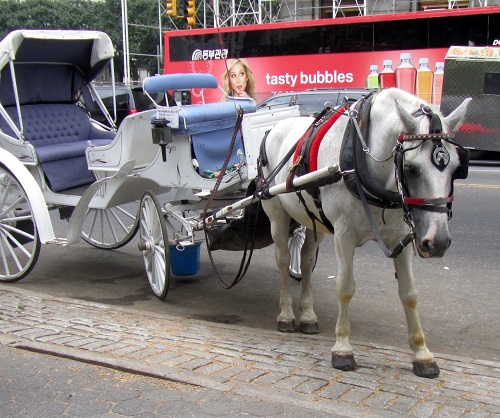
sad horse

Horses in the carriage industry are often castoffs from the harness racing industry or from Amish communities and come to the city with pre-existing health problems. They develop further health issues from walking on pavement all day and breathing exhaust from trucks, cars and buses. They work all day in freezing cold and scorching heat and they’re stored in warehouses at night.

They’re never sent out to pasture, and have no government protection. Carriage owners are legally allowed to work their horses 9 hours a day, seven days a week–whether horses like it or not.

don't take a ride

The average working life of a carriage horse is only four years. In fact, about a third, or approximately 70, of the New York City carriage horses are eliminated from the Department of Health horse registry every year. When they’re spent, they’re usually auctioned off for slaughter or rendering plants for dog food companies or zoos.

stuck in traffic

The horses suffer and people are endangered too. Horses get spooked easily and can run into traffic. In New York there have been more than 18 accidents involving horses in the past two years. It’s a largely unregulated industry.

It’s a half-hour ride for patrons, but it’s a lifetime of misery for the horses.

Toronto, Paris, London, Las Vegas, Beijing and many other cities have already banned carriage horses. A fun horseless carriage idea is brewing that could replace horses in New York and still be fun and romantic.

In Savannah, I opted to take a pedicab ride. The man peddling told me he enjoys the job and that it’s paying for his college.

pedicabs instead

What to do?

  • Never patronize carriage rides, and tell your family and friends why they shouldn’t. From newlyweds to tourists, it’s the people paying for the rides that keep this industry in business.
  • If your city allows carriages on city streets, urge your legislators to propose legislation that will ban it.

Update (Jan 2, 2014) – New York City Mayor-elect Bill de Blasio has vowed to ban horse-drawn carriages in the city and retire the horses to sanctuaries. Money to help the horses is probably still needed and horses in other cities still need help. This promise is great news, and a good way to keep momentum going for the horses.

Resources:

Unknown's avatar

Bird-brained: Animal name calling

Sly like a fox. Eagle eyes. Busy as a beaver.

There are a lot of animal-themed metaphors, similes and idioms in our vernacular. They’re so second-nature that I rarely notice myself saying them. Some expressions come from an animal’s natural characteristics and I don’t mind using them.

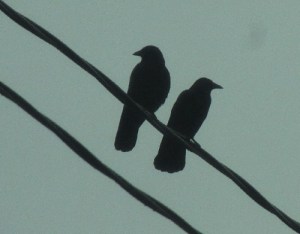
two crows

What’s wrong with being a night owl, for instance?

Other times, expressions belittle animals of have an inherently cruel theme. Yes, stick and stones may break bones, but words are powerful and I’m trying to adopt a more inclusive vocabulary. Not because it’s politically correct but because the way we talk affects the way we think. I’ve already written about animals and gender-specific pronouns, and now I’ve compiled a list of some expressions I’m trying to avoid:

  • Too chicken (to do/say something); chicken out
  • Pig, pig out, or eat like a pig
  • Ugly as a toad
  • More than one way to skin a cat
  • Chicken in every pot
  • Bleed like a stuck pig
  • Like a chicken with its head cut off
  • Kill two birds with one stone
  • Not enough room to swing a cat
  • Kill the fatted calf
  • So hungry I could eat a horse
  • No point beating a dead horse
  • A bird in the hand is worth two in the bush
  • Shooting fish in a barrel
  • Bigger fish to fry
  • Big enough to choke a hog
  • Don’t count your eggs before they’ve hatched
  • Like a lamb to slaughter

Here are some that I think are fun and appropriate:

  • When pigs fly
  • Gentle as a lamb
  • Have your tail between your legs
  • Water off a duck’s back
  • An elephant never forgets
  • Let sleeping dogs lie
  • It’s a dog’s life
  • Every dog has his day
  • Horse around
  • In the doghouse
  • Raining cats and dogs
  • Quick as a rabbit
  • Two shakes of a lamb’s tail
  • Eagle eyes
  • Sharp as a hawk
  • Birds of a feather flock together
  • Lion-hearted

I’m not going to go ape and bark up the wrong tree if you don’t take the bull by the horns, but can you think of other suitable or inappropriate expressions? Can you think of alternatives for the unsuitable ones?

Unknown's avatar

Fashion saves the birds

You might sometimes think that fashion has gone to the birds, but in the 1920s, it actually saved a few species.

You see, in the late 1800s, large, ornate hats were all the rage. Adorned with lace and pearls and feathers, some even had entire bird nests or cages incorporated into them! And a Victorian lady never left the house without a hat.

plumed hat

Hunters descended on the Florida Everglades in search of spoonbills, flamingos, herons, and egrets. These birds were favored for their plumes so they were killed by the millions. Conservationists tried to stop the massacre (around this time a few of them formed the National Audubon Society), but still the demand grew.

Eventually, feathers were worth more than double their weight in gold! That meant it was more lucrative (and easier) to kill birds than to pan for gold. In a time when a month’s rent was $10, the plumes of four birds would fetch $32.

birds shot for their feathers

Hunters shot every adult bird they could find, leaving orphaned chicks and unhatched eggs to die. Two generations of birds were wiped out because of a fashion trend.

Even after hunting was outlawed, the slaughter continued. One of the country’s first game wardens, Guy Bradley, was hired to patrol southern Florida and prevent poaching. He was murdered by a hunter while protecting the Everglades. Two other men–a game warden and a deputy sheriff–were killed soon after.

Egret

It seemed like nothing could save the birds and end the senseless bloodshed of human and animal life.

Then, the Jazz Age hit and flappers abandoned large hats for bobbed hair and smaller hats or headbands. As the demand for feathered hats diminished, bird populations began to recover.

bob cut

Perhaps the flappers didn’t choose a new style because they thought of the birds, but the shift in sartorial trends made a huge impact on animals. All it took was for people not to buy feathered hats. It’s a simple strategy that we can do today: decrease the demand to stop questionable practices.

Animal ingredients are in many articles of clothing. When you shop, you can look out for (and avoid buying) products containing fur, leather, wool, feathers, silk, coral, horns or bone.

Every time we buy something we’re voting with our dollars. Industries thrive or wither away because of consumer choices. That’s a powerful thing.

References:

Unknown's avatar

Compassionate Couture

I like to vote with my dollars. And one way to do that is support vegan businesses and ethical companies. That’s why I shop at Compassionate Couture.

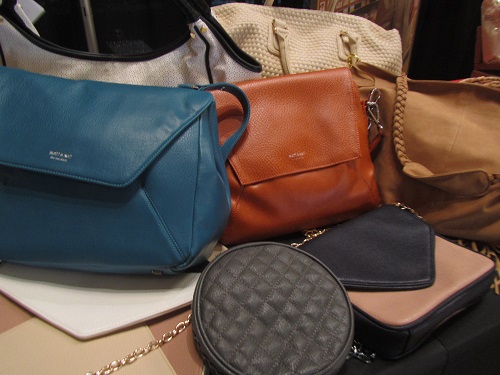
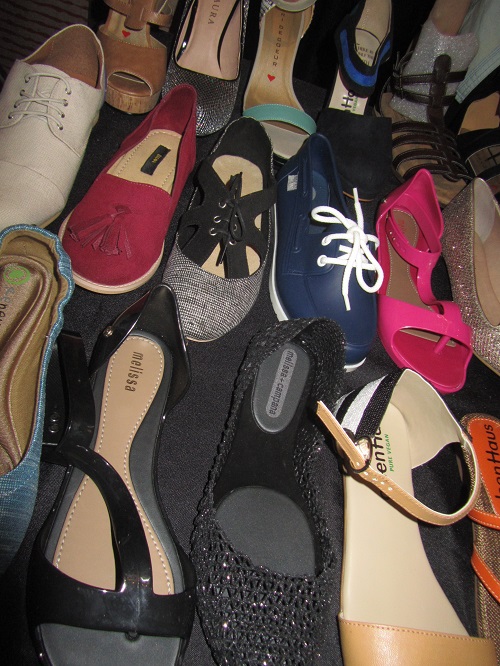
I met Jill and Tracey, the sisters who run Compassionate Couture, when I was at the vegan bloggers convention this past spring. I was smitten with their shoes and bags. I really enjoyed talking to Jill and Tracey too. They have a passion for what they do. If you know me, you know I’m a fashion lover. But it has to be compassionate!

purses

shoes

After looking at their wares, I decided on a pair of comfy ballet flats. I paid at the convention and had the shoes shipped to me. Compassionate Couture is an online shop and they can ship to you too! Lucky for us, they’re having a sample sale with prices up to 70% off!

Sample Sale Image

If you’re in the market for quality vegan, eco items from sustainable companies like Cri de Coeur, Matt & Nat, or Novacas, go to Compassionate Couture’s site and see what they have.

Unknown's avatar

Vegans wear makeup too

I’m getting ready for a trip and, as a light packer, I’m already planning what to bring. I only use products that are vegan and haven’t been tested on animals. Here’s a look at what’s coming with me.

makeup

My Arbonne day cream isn’t makeup per se, but it’s got SPF 20 and is an important way to start my make-up routine. I’m also bringing a tinted moisturizer with SPF. This Josie Maran is a great substitute for foundation and has SPF 30. It’s a great no makeup look. I find it really natural-looking and they have shades for almost anyone.

I’ll definitely need a concealer and this little tube (lower right) by Too Faced is perfect for under my eyes or to cover a blemish.

I light dusting of powder foundation is optional, but I like to be prepared. The Bare Minerals foundation also has SPF and is a nice way to mattify is sunscreen gets me shiny.

This Stila kit has five shadows that I can mix and match for day or night and a convertible lip and cheek cream. It includes a mirror and folds flat. Update: Stila is not longer a cruelty-free company.

I’m packing a dark brown eye liner by Jordana (proving you don’t have to buy from higher-end brands to get a good product). I buy Jordana because it’s inexpensive, goes on smoothly and gently, and is available in a myriad of colors. Plus, just about any drug store carries it.

I can’t live without my Stila liquid brow liner. Since Stila stopped being cruelty-free, I’ve discovered Milani. Not all of their products are vegan, but their site has an entire vegan section. I love Milani’s mechanical brow pencil. The secret to a natural look is the right shade. I use taupe, and I make tiny brush strokes in the direction of my brows. It’s great to fill in and define. Well-defined brows really frame the face and are youthful looking.

My BWC (Beauty Without Cruelty) mascara is also a must. If I had to narrow down my routine to three products it would be brows, lashes and lips.

I packed a bright red lip stain from Stila because it’s an easy way to go from day to night and the cheek cream in the kit is pretty neutral.

Finally, Booda Butter keeps my lips moisturized day and night. I have one in my purse at all times.

As for my other skin and body care, here’s what I’m taking.

skin care

If I were going to a hotel, I’d skip the shampoo and body wash, but I’ll need my own so I’m packing a solid shampoo from Lush (just lather like soap and apply to wet hair like you would a liquid shampoo). It’ll be nice to pack a solid because I won’t have to worry about it in my carry-on (or at security checks).

I’m taking 3 ounces or less of hand sanitizerbody wash, a small tube of sunscreen (when I went to Hawaii I packed four little tubes instead of one big one–to make my bag carry-on approved), night cream, a bit of hairspray in a carry-on spritzer, hand sanitizer and a face cloth. My Norwex face cloth removes makeup better than a makeup remover so it’s one less liquid I have to pack.

So there you have it. What are your travel makeup essentials? Are you a light packer like I am or to you prefer to be prepared?

Unknown's avatar

My vegan dog

My dog eats vegan dog food. Have I lost my mind? Am I forcing my beliefs on my poor dog? Not at all! Let me explain.

Frankie is an 11-year-old rat terrier. Ever since I adopted him when he was five, I was interested in feeding him the healthiest food I could find. I started with a high-quality, human-grade, fish-based food, thinking I’d be avoiding factory-farmed meat. But fish is often factory farmed too. And the oceans are being depleted, so wild-caught is just as bad. Fish are sentient beings and I couldn’t justify it.

Later, I made Frankie homemade vegan meals, to which I added Vegedog, a powdered supplement especially made for dogs. Frankie loved it, but planning his meals was a lot of work. Besides, Frankie will eat anything. Cheap kibble, human food, garbage, cat poo. I felt like my culinary skills were being taken for granted.

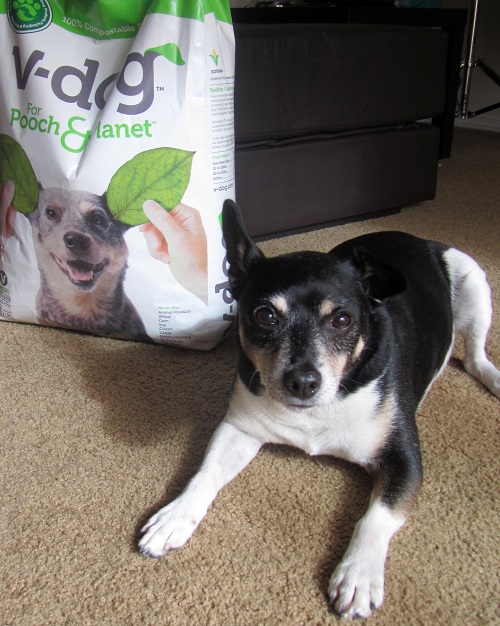
frankie with his v-dog

Then I found V-Dog, a cruelty-free kibble. It’s free of wheat, corn, soy, fillers, GMOs–and of course animal products. Frankie loves it. He has lots of energy, and “clean up” is better too (by which I mean, good in, good out).

As for me forcing my beliefs on Frankie, here’s how I see it. In the wild (well, dogs are domesticated, but you know what I mean) dogs wouldn’t be eating prepackaged food. They wouldn’t be chemical-laden, not-fit-for-human-consumption castoff meat bi-products from factory farms. Reality is, most commercial dog food is crap. The parts of the animals that people don’t eat are sent to rendering plants for pet food. The diseased animals, the ones with tumors, even roadkill and euthanized cats and dogs, can end up in dog food.

In the wild, Frank would be a scavenger, an omnivore. He loves watermelon, but he won’t turn down meat. For him it’s not a moral issue. For me it is. I had a hard time aligning my vegan values with the fact that I bought him meat-based food. Heck, some pet food companies even test on animals. Luckily with V-dog, I don’t have to compromise.

There are other vegetarian dog foods on the market (like Evolution, Ami Dog, and Natural Balance vegetarian formula) and if you have a dog, I’d encourage you to try a few and find one that suits him or her best. I chose V-Dog because it’s a vegan-owned business and is recommended by a host of organizations, from veterinarians to animal sanctuaries.

Resources:

Unknown's avatar

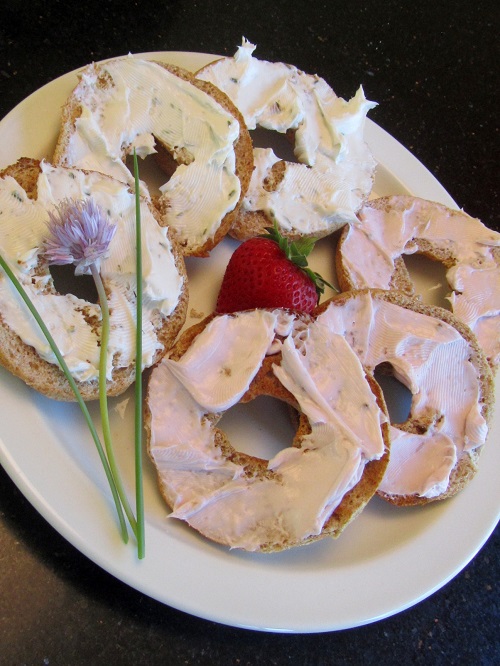
Daiya vegan cream cheese

I was recently offered the chance to test some products by Daiya. I’d already tried Daiya dairy-free cheese slices and I’d heard about their new spreads, so I eagerly signed up for the job.

Daiya spreads

Daiya is vegan, so it’s naturally lactose- and casein-free. Unlike some vegan spreads, it’s also soy-free, so if you have a soy allergy, don’t worry! I kept things simple for my first tasting: mini bagels and two types of spreads. I wanted to experience the flavor of the product.

The chive and onion was amazing! It’s a smooth, creamy spread and satisfied my bagel-and-cream-cheese craving. The strawberry was a real treat! I bet I could make a great cheesecake with it. The Daiya site has lots of recipes, so you can try new dishes.

chives or strawberry

Daiya is named after the Sanskrit word Dayaa, which means “loving, kindness and compassion.” I love that Daiya Foods is founded on these values. Voting with my dollar is important and supporting ethical companies is something I’m always happy to do.

The thought of giving up cheese is often what holds people back when they contemplate veganism. Well you don’t have to give up anything! You can have the cheesy comfort foods that you’re used to making and you can eat cruelty-free. You’ll also reap the health benefits of a plant-based diet when you ditch dairy.

Look for other reviews. I’m going to try Daiya shreds either on a pizza on in a cheddar beer bread recipe. I’m also going to perfect a grilled cheese sandwich using their wedge.

Have you tried Daiya?

Unknown's avatar

Farm Sanctuary message gear

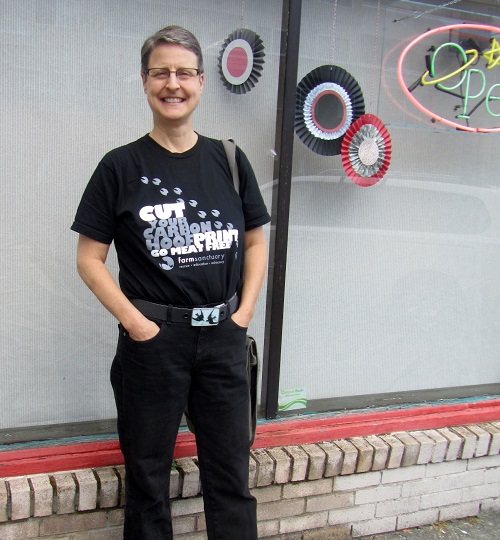
I recently met up with my friend Barb, of healthnik.org. We caught up over lunch at Araya’s, a vegan Thai restaurant in Seattle’s university district. Their all-you-can-eat buffet is not to be missed! After lunch, we walked a few doors down to Vegan Haven, Seattle’s only all-vegan grocery store. I got Barb to pose for me out front. It seemed like a good backdrop for a photo shoot featuring vegan wear.

Barb bought her belt at Vegan Haven. It’s made of recycled conveyor belt. She replaced the plain buckle with a unique bird buckle from the co-op in Mount Vernon.

Barb had just come back from New York State and told me about her experience visiting Farm Sanctuary.

Barb in FS gear

T-shirt: Farm Sanctuary
Jeans: Calvin Klein via Goodwill
Belt: Held Belts
Belt buckle: FluffyCo
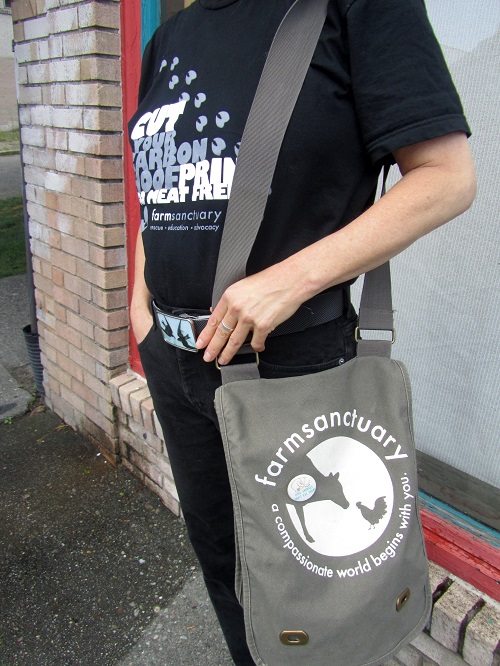
Bag: Farm Sanctuary

The tour was a very positive experience. She got to meet a lot of rescued animals and learn about each of their unique stories. While she was there, she picked up a few pieces of merch.

Barb is wearing a T-shirt from Farm Sanctuary with a vegan/environmental message: Reduce your carbon hoofprint: Go meat-free! Environmentalism and veganism go hand-in-hand. Factory farming is a bigger source of carbon emissions and pollution than all the transportation industries combined!

Barb also picked up a great shoulder bag. It looks perfect for carrying a couple of books or magazines. It would fit a camera nicely too, and probably is big enough for a tablet or iPad. Plus, the message is clear.

Shoulder bag

Barb was thoughtful and brought me a pin and magnet. The magnet is on my fridge. Look at that cute lamb!

lamb

I think everyone should visit a sanctuary. If you’re not vegan, you’ll see first-hand why ditching meat, milk, and eggs is a great idea. If you’re already vegan, you’ll be uplifted by seeing the ones who made it out–animals who were destined for the dinner table and were saved because of the hard work of the Farm Sanctuary people (and donations from its supporters).

Farm Sanctuary has locations in New York and California, but there are many other sanctuaries. Your area might even have one. If not, planning a trip near a sanctuary is a great reason to visit one.

Unknown's avatar

Gender-specific pronouns and animals

One step in learning to treat animals as sentient beings, not mere objects, is to use gender-specific pronouns. A dog is not a thing. Nor is a cow, eagle or mouse.

I’ve read numerous news stories about animals and for the most part, animals are called “it.”

  • The pig and its piglets were rescued – No, it’s her piglets. We know that because only females can give birth.
  • The steer broke its neck – No, it’s his neck (and the cowboy broke it). Steers are male.

If don’t know the gender of an animal I’m talking about, I assign one. In a story about two animals, one becomes he and one becomes she to make the distinction between the animals clear. “The raccoon chased the squirrel, who ran up a tree. She stayed in the tree for a while but he started pacing so she came down. He licked her forehead and they walked away together.”

Unlikely example aside, I believe gender-specific pronouns matter (and using one matters more than getting it right). This might even be why I give animals human names. My dog is Frankie. My cats are Alice and Margot.

rabbit

She likes eating my plants, but I don’t mind.

I tend to call dogs he and cats she because I speak a little German and in German cats are assigned a female pronoun (die Katze) while dogs are given a male pronoun (der Hund). This has less to do with sentience and more to do with grammar. In German a hat is masculine and banana is feminine (der Hut and die Banane).

Other languages like French and Spanish assign gender to animals and inanimate objects too so I’m really talking about English, where we know an animal is a he or a she but we say it.

Calling an animal he or she won’t stop cruelty. It won’t turn the world vegan either. But I think it’s a small step toward acknowledging that animals are thinking, feeling beings with a similar range of emotions to humans. They show fear, love, anger, frustration. They can be silly and funny or shy and reserved and we need to think of them as individuals not commodities.

Farm Sanctuary has a Someone, Not Something campaign that addresses this. They focus on farmed animals because we already tend to look at cats and dogs as family. Conversely, many people see cows, pigs and chickens as things to eat.

Next time you’re talking about animals, listen to yourself and see how you refer to them.

Unknown's avatar

Running of the bulls

It’s time again for another blood sport bath. Every summer from July 6th to 14th, the San Fermin Festival takes place in Pamplona, Spain. It’s a festival honoring Saint Fermin, a 3rd Century Roman who converted to Christianity.

Sadly, the festival revolves around the running of the bulls. Every morning bulls are forced onto slippery cobblestone streets filled with thousands of crazed revelers. As fireworks and explosives go off, the terrified animals run through a cordoned off section that creates a chute of sorts. The route leads to a bull ring, where they will be tortured and killed.

Photo credit: Bernard bill5 at nl.wikipedia

The festival is steeped in tradition related to transporting bulls to market. Today, it attracts stupid (mostly) men, many of them tourists, who think running among terrified animals makes them macho. It’s not brave or masculine. It’s shameful.

Many Spaniards oppose this cruelty. This year, animal rights activists from PETA UK and Spain’s Anima Naturalis joined forces to demonstrate against the barbaric practice. They stood in coffins (representing the 48 bulls that will be killed during the festival) to protest.

Photo credit: RAFA RIVAS/AFP/Getty Images

The San Fermin festival attracts thousands of tourists to watch the bull runs. Bull fighting is actually on the decline but tourism keeps it alive. When travelling, stay far away from bull fights and other forms of cruelty and vote with your dollar. Spain is a beautiful country so enjoy the scenery, hospitality, dance, art, architecture, nature and beaches instead.

Benjamin Zephaniah, writer and poet, says it best: “Tourists who participate in the run or visit  Pamplona simply to watch it contribute to the carnage. Every shared tapa, every cerveza, every  booked hotel room and balcony bolsters the killing. As long as the city makes money off the event, bulls will continue to suffer and die.”

The festival isn’t really about the saint behind the name. If a raucous drink-fest is what people are looking for, there are lots of ways to do that, from dance clubs in Ibiza to music festivals. At least at La Tomatina, animals aren’t involved, although throwing tomatoes around is a waste of good food.

In a fun 21st Century take on a cruel tradition, New Orleans has their own running of the bulls festival, where roller derby skaters from the Big Easy Rollergirls league play the part of bulls. You can run down the street and get knocked over by a derby player. Drink, sing, dance and no animals get killed! In fact, part of the proceeds from the event support Animal Rescue New Orleans.

There’s always a way to keep traditions alive with new, fun versions of outdated cruel practices. Last year 12,000 participants were chased by over 350 RollerBulls!