Unknown's avatar

Film review: Blackfish

I was lucky to snag a ticket to a showing of Blackfish at the Seattle International Film Festival. Blackfish reveals the complicated life of Tilikum, an orca born in the wild off the coast of Iceland. As a young whale, Tilikum was forcibly separated from his mother and sent to perform at a marine park in Victoria BC. He’s been in captivity since 1983 and is currently confined at SeaWorld in Florida.

The documentary reveals the frustrations Tilikum has endured and how he’s been picked on by other whales in his pool, cooped up in a dark “garage” of sorts during off seasons, and forced to perform year in and year out.

Orcas similar to Tilikum

Out of his frustrations, grew an aggression that wild orcas don’t display toward humans. Tilikum has killed three people, two of which were trainers.

The movie shows the horrors of wild capture and captive breeding. It documents the unnatural acts orcas are forces to perform in front of clueless audiences. The charade SeaWorld conducts is shameful. They lead people into believing these beautiful whales somehow enjoy their time in captivity and are safe and happy.

On the contrary, an orca’s life in captivity is extremely short. They live on average for 9 years from the time they are captives–regardless of how old they were when they entered captivity. In the wild, male orcas can live about 60 years; females up to 100.

Orcas, also called killer whales, live in family units called pods. Each pod speaks a different “language.” They live with or near their pod for their whole lives and travel about 100 miles a day. They are extremely social and have highly developed emotions. To see families separated and grief-stricken and captive whales isolated in concrete pools was heartbreaking. But the film is an important movie to watch.

Blackfish will be released in NY and LA later this summer, and more widely after that. CNN Documentaries is distributing the film on TV in the fall.

It’s a terrific resource and the things you’ll learn apply to all captive marine animals. Sadly, SeaWorld is one of the better marine parks. There are many more orcas who languish is worse conditions, including many at Canada’s Marineland.

What to do

First of all, never go to a marine park like SeaWorld or Marineland. Ask your friends not to go and talk to schools about canceling field trips to marine parks. Marine parks exist for one reason, and one reason alone: making money. Vote with your dollars and spend your time and money somewhere else.

Look at the websites below for information about how to help. Two orcas, Morgan and Lolita, are great candidates for release.

Resources

Blackfish website – Information about the movie, including the trailer and upcoming screenings.

Orca Network – Information about whales in the Pacific Northwest, creating safe whale habitats, and the Free Lolita campaign.

Voice of the Orcas – Interview and current event about conservation and activism.

Miami Sea Prison – Information about captive orcas and the fight to release Lolita, the last surviving whale from the L Pod hunt in 1970.

Free Morgan Foundation – The campaign to release Morgan, an orca currently in captivity in The Netherlands.

Marineland Animal Defense – A campaign to end animal captivity at Marineland in Niagara Falls Canada.

Unknown's avatar

Vida Vegan Con 2013

I already wrote about the nine-hour Portland bloggers pre-funk, but what about the actual event?

Well, it began unofficially with a supermodel scramble at one of Portland’s original vegetarian restaurants, Paradox Café. I had breakfast there with Vegan Score before heading to registration.paradox cafe

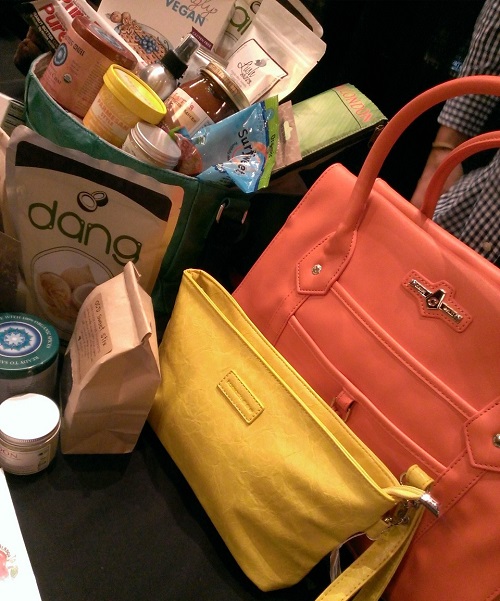
The conference was at the Portland Art Museum. Registration was all morning long, which gave people time to check in without long lines, grab a latté, explore the museum, and find long-lost friends. We grabbed swag bags and checked out the exhibitors hall, both of which were filled with vegan goodies.

swag

merch

On Friday I attended the following sessions: Blogging as Writing, Monetizing Your Blog, Expanding Your Message to Include Animal Rights, and the MoFo (Month of Food) Workshop. All the sessions were helpful and I gained the most from the animal rights one. I learned that through gentle suggestions, reminders–even humor–I can let people know about how to eliminate cruelty. Jasmin Singer from Our Hen House said something as simple as, “I made this recipe without eggs because I don’t like how hens are mistreated” goes a long way to getting people to think about their impact on the world.

After the sessions, Veggie Grill hosted a delicious reception and then a lot of us headed over to the world’s only vegan mini mall. I met up with Vegan Moxie, Vegtastic, Vegans Don’t Bite, and whole bunch of others. I am in the habit of calling bloggers by their blog names, but I assure you, they all have proper names too! We had vegan gorditos at Food Fight, vegan s’mores at Herbivore Clothing, and lattés at Sweet Pea vegan bakery. After filling our bellies I went to Hungry Tiger, a vegan-friendly bar, for a drink with the Fat Gay Vegan, Vegan Score, and The Messy Vegetarian Cook.

vegan mini mall

Saturday started with a scrumptious breakfast buffet at the conference, followed by these sessions: Ethics Beyond the Plate, Vegan Invasion, Finding Balance, and International activism. Mind you, these are only the sessions I attended. There were three going on at any given time–from iPhone Photography to Vegan Parenting. There was something for everyone.

snacks by Peanut Butter & Company

We broke for lunch halfway through the day and I was still full by the time I got to the gala. We had lots to choose from: a vegan sundae bar, vegan artisanal cheese table, drinks, dancing, and of course, the silent auction to benefit Chimpanzee Sanctuary NW. We raised over $4000 for them!

gala

sundae bar

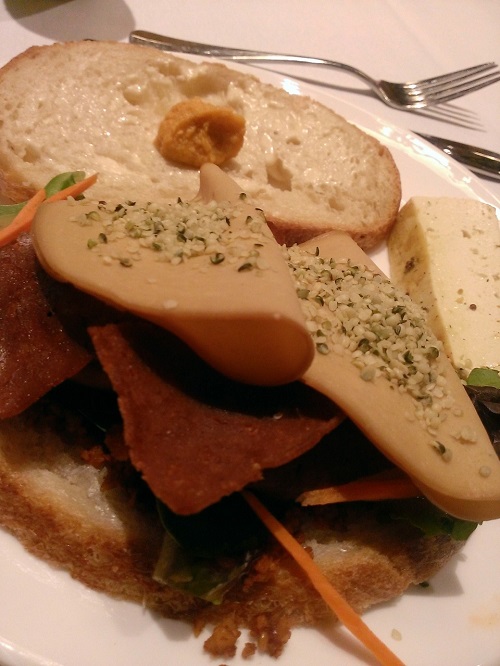
Sunday began with another great breakfast. I attended four sessions: Publishing, Body Image, Social Media, and Interdietary Co-habitation. Of course we had another great lunch–a sandwich bar!

sandwich

I was sad when things wrapped up for the day, weekend, year. I’d made new friends, got to know acquaintances from online and in Seattle, and reveled in the company of kind and compassionate people. Everyone had a different story. There were 20-year-old bloggers and 60-year-old ones. We came from all walks of life, but we were united in our love of animals, health, the earth, and of course food.

I’m excited for the next event and I have a lot of blogs to read in the meantime.

Unknown's avatar

In-vitro meat becomes a reality

I’ve been wanting to write about the sci-fi notion of in-vitro meat for a while now. In-vitro meat (also called cultured, test tube, or lab-grown) is meat that is “grown” from cells in a petri dish, not from a living animal.

This week, however, the New York Times reported on this phenomenon. So sci-fi is becoming reality. Time to take a look at what the meat of the future could look like.

test tube

In the prototype, beef muscle tissue is grown into a piece of meat. This isn’t vegan, of course, since the source is from a cow. Future versions could be non-animal based.

Would you eat meat grown in a lab? I still stand by the loads of scientific research that shows how unhealthy meat is. It clogs arteries, provides no fiber, turns on cancer cells, and promotes diabetes, heart disease, and obesity. But if mainstream America doesn’t jump on the vegan bandwagon, I’d rather they buy lab-grown meat than support the slaughter of sentient beings.

Eating in-vitro meat bypasses the factory farm and slaughterhouse. It skirts around issues such as dehorning, debeaking, castrations without anesthetic, transportation, water and grain consumption and land use. It’s environmentally much better.

For me, going vegan was about reducing suffering so I’m personally on board with in-vitro meat. I’d still like to see people adopt whole food plant-based diet though.

This technology might also be able to “grow” leather in a lab, so there really are a lot of possibilities.

Unknown's avatar

An Apology to Elephants

HBO An Apology to ElephantsWhat’s the problem with the elephant in the room?” asks veterinarian Mel Richardson rhetorically in the new HBO documentary An Apology to Elephants. He answers his own question: “the room.”

The problem of elephants in captivity is the heart of this film, narrated by Lily Tomlin. It guides viewers through our complicated relationships with elephants. It shows beautiful footage of wild herds and contrasts them with heartbreaking scenes from circuses and zoos.

The documentary interviews several elephant experts, including the late Pat Derby, co-founder of the Performing Animal Welfare Society (PAWS). Her sanctuary in California is a refuge for elephants.

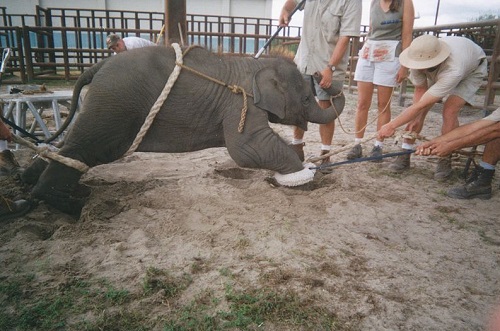
The film is difficult to watch. Elephants in circuses and zoos are trained through forced submission and physical violence. The bull hook is an instrument of torture and the elephants learn to fear whoever bears one. But it’s important to know about the plight of captive elephants. How they’ve been ripped away from their families in Africa and Asia just to entertain us.

baby elephant training (PETA)

The performances that these majestic elephants are forced to participate in seems to mock their very elephant-ness. The ringleaders have stench of colonialism on them. Conquer, dominate, exploit, profit.

Ringling Brothers Circus (Amy n Rob)

Elephants have been exploited for a long time. They’ve been used to perform hard labor, as instruments of war, as objects of entertainment, as transportation–not to mention being killed for their meat and ivory. Humans have been unkind to pachyderms and we owe them a better future.

Elephants in the wild form tight social bonds. Male babies stay with their mothers for up to 15 years. Females never leave the matriarchy.

The Oakland Zoo is featured prominently in the film as an example of a zoo that is changing. They’ve increased the enclosure (it’s still just 6 acres, but that’s six times bigger than Seattle’s paltry enclosure). Instead of direct contact (which involves bull hooks), they use indirect contact so trainers are never in the same area as the elephants. When they do interact with elephants, it’s through a fence and with positive reinforcement.

bullhook (IDA)

The trainers acquired the elephants through other, sub par zoos, and to my knowledge they aren’t breeding them. They acknowledged that the wild is the best place for elephants but since these ones can’t be released into the wild, improving their living conditions is the next best thing.

I don’t support zoos and I would like to see the Oakland Zoo elephants to go a sanctuary like PAWS too. Profiting from animals, whether in a zoo or circus, isn’t right. But on the spectrum of elephant treatment, Oakland is doing a whole lot more than most places.

After seeing this film, you can bet I’ll be at the circus the next time it comes to town–protesting it! In this area, Ringling has learned to stay out of Seattle, but they still come to Everett and Tacoma. I’ll be there, speaking up for the elephants who can’t. Elephants as old as I am who see nothing but the inside of trucks, the sharp end of a bull hook, and the jeering crowds in a circus tent.

I’ve written the Woodland Park Zoo in Seattle and asked that their elephants be released to a sanctuary. I encourage you to do the same. Write to the officials in Seattle or your local zoo.

Resources:

Have you seen An Apology to Elephants? What did you think? Do you know of other captive elephants who have campaigns to help them?

Unknown's avatar

Protesting primate research at the UW

This past Saturday The Northwest Animal Rights Network (NARN) held a demo outside the University of Washington National Primate Research Center. We organized the event to coincide with World Week for Animals in Labs.

Hidden inside this dark, unmarked building, 700 primates live and die for research, subjected to painful surgeries and traumatic procedures until they aren’t useful anymore. The Blue Building at 3000 Western Avenue downtown Seattle is the main facility for the UW National Primate Research Center, the largest of eight across the country.

About a dozen of us spent a few hours with signs and fliers and shared info with passers-by. Many people were shocked to learn that wasteful and cruel experiments were happening in their neighborhood. The beautiful Seattle sculpture park is across the street, and no one suspects cruelty is around them.

blue building

The University of Washington spends millions of taxpayer dollars conducting needless tests that haven’t resulted in any contribution to humans or animals. Harvard recently decided to close its primate research center and it’s time for UW to do the same.

The UW has even been cited with safety and cruelty violations including performing unauthorized surgeries and letting a monkey starve to death. The university breeds monkeys too and removes babies from their mothers soon after they’re born.

wwail collage - group photo by Pam Pulver

We demo to let the public know about these atrocities but we also demo to let animal abusers know their deeds aren’t going unnoticed. As I’ve written about before, animal research isn’t good science.

What can you do?

Send a polite letter requesting the UW reevaluate its policies regarding animal experimentation and commit to long-term reduction of the use of any animals for science.

Michael Young, President
301 Gerberding Hall, Box 351230
Seattle, WA 98195
206-543-5010
pres@uw.edu

The University of Washington Board of Regents
139 Gerberding Hall, Box 351264
Seattle, WA 98195-1264
206-543-1633
regents@uw.edu

If you’re a UW grad, you can also contact the alumni association and tell them that you won’t join them (or that you’ll be cancelling your membership) unless the university agrees not to use live animals in their research.

UW Alumni association Box 359508
Seattle, WA 98195-9508
206-543-0540 or 1-800-AUW-ALUM
uwalumni@uw.edu

Unknown's avatar

World Week for Animals in Labs

We’re midway through World Week for Animals in Labs (WWAIL) so I thought I’d put together a little post about a few things that are going on.

wwail dog by MaréWWAIL is a week when activists join forces to be a loud voice for the voiceless. There are millions of animals languishing in laboratories all over the world: rats, mice, cats, dogs, rabbits, primates, and others. Anytime is a good time for activism, but this week is a time when we can stand up together and say “no more.”

It’s a good time to remember to donate only to charities that don’t test on animals and buy household cleaners and cosmetics from companies that don’t test on animals either.

Victories

Just today, Harvard Medical School issued a statement announcing that the New England Primate Research Center will be closing within 24 months! The center has been embroiled in controversy following the negligent deaths of at least four primates. The facility is currently under investigation by the USDA and faces a potentially major federal fine for multiple violations of the Animal Welfare Act. This news couldn’t come soon enough! The animals deserve a chance to live out the rest of their lives at sanctuaries. Read the details at the Stop Animal Exploitation Now (SAEN) website.

Last month the entire European Union–that’s 27 countries and half a billion people–banned the sale of new cosmetic products containing ingredients tested on animals. The ban goes into effect immediately, and will prevent testing on countless animals. Real progress comes from non-animal research such as genomic tests, human cell cultures, medical imaging and clinical trials. Read more about why animal testing is a bad idea.

Action

Look for WWAIL events in your area and join the growing number of people who say no to cruelty.

If you’re in the Seattle area, you can join the Northwest Animal Rights Network (NARN) at a demo this Saturday, April 27th from noon to 2 pm in front of the University of Washington Primate Experimentation facility at 3000 Western Avenue in Seattle, WA.

Hidden inside this dark, unmarked building, 700 primates live and die in the name of research. They are subjected to painful surgeries and traumatic procedures until their usefulness is over. The building is the main facility for the UW National Primate Research Center, the largest of eight across the country.

NARN wants to educate passers-by about what goes on behind the walls of the “blue building” and hold researchers accountable. They need to know that what they are doing to animals is not going unnoticed and that it will be challenged until it stops.

Unknown's avatar

What’s wrong with leather?

I recently wrote about vegan shoes and vegan purses. Some people might ask, “What’s wrong with leather?” Up until recently, I was one of those people. So let me share with you what I’ve learned:

Leather is not a byproduct of the meat industry. It’s a co-product. When I was a vegetarian I wore leather shoes, jackets, belts and bags. I thought leather was a byproduct that would be wasted if no one turned it into things I could wear.

Then I learned that the profit margins on meat are relatively small and that leather brings in a lot of money. Half the value of the animal! So by buying leather, I was supporting the meat industry.

That’s when I switched to buying only second-hand leather. But I’ve stopped that too. I’m grossed out now at the idea of wearing someone else’s skin. It’s a little too Hannibal for me. I also realize that I’m promoting leather when I wear it. Others might not know I bought that jacket used and go out and buy a brand new one.

I still have a few pair of leather shoes and I’m in the process of selling them. With the money I made selling my other leather shoes and jackets I bought a few awesome pair of leather-free shoes. My favorite so far are the Novacas booties. They’re an all vegan company that focuses on workers’ conditions, ethically sources materials, and environmentally friendly business practices.

novacas

Faux suede booties by Novacas

Which brings me to the other problem with leather: It’s not green.

The reason leather shoes don’t rot away like roadkill is because of chemicals. Leather is tanned with an acidic chemical compound that preserves it. Leather is soaked in biocides and fungicides to prevent mold, and it’s treated with nasty concoctions like sodium sulfide to remove the hair. Even chemicals like arsenic and formaldehyde are used.

pile of leather

Stack of tanned leather

In places where leather production is prevalent (such as India and China), water and air pollution is high. Workers (and nearby residents) also face high instances of cancer from all the chemicals.

Finally, not all leather is a co-product. Kangaroos in the outback are shot for their skin. Exotic animals are turned into leather goods too–and they’re terribly mistreated in the process. Snakes are often nailed to trees and skinned alive. Lizards are clubbed to death, and alligators are crowded in filthy pens on farms killed when they are big enough to be marketable.

Fortunately, there are lots of cruelty-free leather alternatives out there. Sure, some are made from petrochemicals, but I doubt they’re worse than the environmental impact of leather. Some are made with good environmental practices in mind and use green (and even recycled) materials. My resources page is a good place to start looking.

Unknown's avatar

Is there such a thing as humane slaughter?

Humane (adj.) – Marked by compassion, sympathy, or consideration for humans or animals.

Slaughter (verb) – To kill animals for food (butcher); To kill in a bloody or violent manner;  To kill in large numbers.

The words humane slaughter seem oxymoronic to me. One can either be compassionate and considerate, or one can kill animals violently and in large numbers.

painting of pigs

I recently read an article in OnEarth.org about Russ Kremer, a man they call the Pope of Pork. He’s being held in such high regard for the wonderful ways he treats his pigs–before he kills them. I realize that there are people who treat animals much worse than he does, but I have a few problems with his approach:

As a boy Kremer worked on his dad’s farm and helped nurse pigs back to health. There’s no victory in saving an animal only to send it to slaughter later. The only gain is financial.

As an adult, Kremer operated his own factory farm, where pigs were warehoused in dark, confined buildings. They were sick, pumped full of antibiotics, and lived above their own waste run-off.  Kremer eventually sold all the pigs he owned, but not until after he got injured by a boar and contracted a nasty virus. The virus was the same antibiotic-resistant version that his pigs had. It wasn’t the pigs’ welfare or the meat-eating population that got Kremer to quit. It was his own brush with death and his own sense of self-preservation.

He didn’t quit farming though. He started raising free-range, organic pigs. The new model nets him $50 more per pig. Again, money is at the root of his choices, not the humane treatment of animals.

I dislike the “new” way of farming because it lulls people into thinking they’re doing the right thing. The “new” method is really just going back to the old, pre-factory farm way. That makes it marginally better than a factory farm, but it still involves extensive use of land, feed, and water. Free-range pigs still produce the same amount of waste that their crated cousins expel. They all still get slaughtered. And when they become sausage, their flesh will clog your arteries just the same.

Neither free range or factory farm is an option from a pig’s point of view. It’s like moving from a prison cell to a mansion. The mansion sounds better but if you’re going to be executed in a few months, what difference do your living conditions make? I bet your biggest concern would be avoiding death.

Throughout the article, Kremer’s pigs are compared to dogs. They’re described as “piglets the size of obese beagles,” and “puppy-like.” But if you talked about how your dog was “bred for well-marbled, tasty meat” people would have you committed! And if indeed you did slaughter your dogs, you’d be arrested. Kremer seems well-meaning, but he’s a businessman. He’s marketing faux-compassion–and it sells. There’s a complete disconnect between the way he “lovingly” raises his animals and the fact that he kills them for money. It’s not euthanasia. He’s not alleviating the suffering of a dying animal, he’s killing healthy animals in the prime of their lives.

Kremer’s business model assumes animals are property, that they don’t have the right to live, and that they are meant for our consumption. No slaughter is good slaughter. Animals deserve to live their own lives; they are not ours to profit from or consume. We don’t need meat to be healthy. Pigs don’t need to die in vain. The only humane choice is to be vegan.

Unknown's avatar

Is animal testing ever justified?

Every year millions of animals are subjected to cruel experiments in the name of cosmetics, medicine and even transportation. They are poisoned, burned, gassed, shocked, overdosed, crushed, blinded, operated on, and deprived any semblance of a quality life. Not only is this cruel, it’s unnecessary. It’s outdated, it’s wasteful, and it’s downright dangerous to humans.

bunnyIf animals are so different from us (different enough for us to justify experimenting on them), it also means they’re too different to gather relevant, conclusive evidence that would apply to us. If they’re similar enough that the experiments would actually be useful and relevant, then they’re just like us and it’s unethical to test on them.

The cost of experimenting on animals is high and the benefits are minimal. Non-animal testing is usually cheaper and more accurate than animal tests, which can be unreliable. Animal tests are misleading because they’re not good at showing how humans will respond.

With animal testing, illness is induced, and then a cure is sought. That’s an unrealistic and unnatural environment and doesn’t translate well to humans. According to the AAVS, nine out of ten drugs that appear promising in animal studies go on to fail in human clinical trials.

For example, the polio vaccine was delayed by decades because of animal testing. Monkeys respond differently to the virus. Penicillin almost didn’t see the light of day because it was ineffective on rabbits (and killed guinea pigs). It wasn’t until Alexander Fleming gave it to a dying patient (as a last-ditch effort) and she recovered that it was proven acceptable for human use.

Thalidomide, a drug used in the 1950s to treat morning sickness, was proven harmless in dogs, cats, rabbits, monkeys, and rats, and was cleared for human use. It wasn’t until over 10,000 children were born with severe birth defects that it was pulled from the market. Animal tests didn’t warn us.

More recently, Vioxx, a painkiller for people with arthritis, was taken off the market after it caused up to 320,000 heart attacks and strokes. The drug was tested on animals but those tests never revealed the danger to people.

So if people have felt animal testing is unethical, why has it continued? Animal testing is big business and gets a lot of grant money. Careers depend on it. It’s also based on old laws and older science–both of which are outdated. You can learn more about this “bad science” by watching a video featuring animal testing opponent Dr. Andre Menache.

Just because some progress seems to have been made via animal testing doesn’t mean that the results wouldn’t have been found out without animals. If I take a flight from New York to Los Angeles with a stopover in San Francisco, it doesn’t mean you can’t get there with a stopover in Atlanta. Or maybe just fly non-stop. There are many ways to reach the same result.

We have the technology to use alternatives to animal tests–and there are many! We have mathematic and computer models, genomic tests, human cell cultures, medical imaging, and crash test dummies. Working on human cadavers to train for surgery is more beneficial than practicing on live animals.

We don’t need animal testing. So vote with your dollars: Don’t support companies that test on animals. Here’s a downloadable list of companies that test and don’t test from vegankit.com, as well as a searchable online list from PETA. Before you support a charity, make sure they don’t test by checking out this list from GEARI.

References:

Unknown's avatar

Born to be vegan

At three years old, I first questioned the ethics of eating animals (in a way that a three-year-old can). By ten I went vegetarian.

For the next 15 years, I was happy about my choice and didn’t see the need to do anything else. It doesn’t hurt hens and cows to eat their eggs and milk (or so I thought), and leather is just a byproduct of the meat industry, so why not wear it?

I’d met a couple of vegans, but I thought they were extreme. I remember going on a picnic with friends, one of whom had a vegan girlfriend. I made a salad and put cheese on the side so she could eat the salad and others could add cheese later. How thoughtful of me!

the future is vegan

I’m happy she didn’t judge. She did, however, recommend a book that changed my life: Diet for a New America, by John Robbins. Robbins was next in line to run the Baskin-Robbins empire and walked away from it all to promote a plant-based diet.

He wasn’t the son of a cattle rancher. It was just ice cream! And I didn’t think cows minded if we used the milk they “gave” us. So I dove into the book to see what all the fuss was about. I didn’t expect to change my lifestyle.

The book opened my eyes to the horrors of factory farming, the cruelty chickens and dairy cows endure to produce eggs and milk. Then there was the environmental impact of eating meat, and the heath aspects of veganism.

I switched to soy milk that day, and dropped eggs from my diet. Cheese was harder to give up, and I indulged occasionally. I still wore leather and hung on to my “byproduct” story.

But when I moved to the US a couple of years later, I wiped the slate clean and started fresh–as a full-fledged vegan. Partly because it was a natural turning point and a chance to redefine myself. But I also chose the move as a time to switch because I’d been reading up on rBGH (bovine growth hormone). Canada hadn’t approved it but it was given to dairy cows in the States. So cheese was off the plate.

I also realized that leather is a big part of the meat industry. A big, money-making part. So I started shopping for leather-free shoes. Turns out, there’s no shortage of options! Until recently, I still bought leather shoes at thrift stores, but I’ve stopped that too.

sandwich

Being vegan is about knowing the truth, being aware, and making a difference. Every time I shop, I vote with my dollars. It truly is a journey. And it’s a joyful one! I absolutely love being vegan. It’s been 13 years now and I’ll never go back. I’m healthy and happy and I still smile every time I eat a delicious, colorful vegan meal.

It’s a peaceful, guilt-free way to live. I’ve never felt restricted. If anything, it’s a fun challenge. Good chefs will make special meals, no matter where I travel, I can find a bite to eat, and my kitchen is a fun place to be. I don’t buy fur, leather, wool, feather (including down) or silk, but I don’t miss a thing. For every one thing I’ve given up, I’ve found three amazing alternatives.

I’ve also connected with a lot of vegans (on Facebook, at work, and through groups like NARN). For people who know the cruel realities of the world, they’re an upbeat bunch. Smart, funny, and fun to be around–and they’re all making a difference in the world.

To quote the slogan on my new tote bag, The future is vegan! Care to join me?