Unknown's avatar

Tail docking and ear cropping

Heidi Montag reportedly had 10 cosmetic procedures done in a single day. Well, whatever you think of that (or her), at least she was a consenting adult.

Dogs are sometimes subjected to amputations when they’re just puppies. Two procedures affect dogs of one breed or another–and they’re both unnecessary and cruel.

Tail docking

Docking is the process of severing the end of a dog’s spinal cord at the dock (or rump). It’s done when puppies are just a few days old–usually without anesthetic! Historically, people docked the tails of ratters, fighters and bull baiters (less for an opponent to grab). But two wrongs don’t make a right! Sometimes docking is done to increase speed or prevent injuries “in the field.” Again, if you’re not racing dogs or hunting with them, this is a moot issue.

I got my dog from a rescue when he was five years old. He already had his tail removed. Even people who buy puppies from breeders (something I do not condone) generally buy their dogs at eight weeks of age–too late to save their tails. Docking inflicts unnecessary pain on dogs and can cause nerve problems. Several countries, such as Australia, Norway, and Turkey, ban it outright. Besides, dogs communicate by using their tails and need them to send messages. It’s hard for other dogs to read a docked dog’s body language. And tails help a dog balance–leave them on!

Frankie

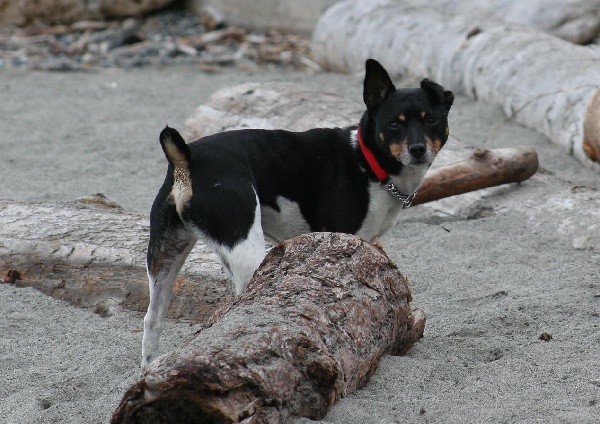
Frankie is a rat terrier and has naturally upright ears (one was torn in an accident and doesn’t stand up anymore). His tail was cropped, however.

Ear cropping

Cropping is the amputation of part of the ear in an effort to make the ear erect. A vet performs the procedure while the dog is under local anesthesia (although unscrupulous people have been known to try DIY versions, which can lead to blood loss, infection, mutilation, and death).

Cropping was historically done on dogs used for fighting, with the thinking being the ear flaps are something for the opposing animal to sink his teeth into. That’s why you’ll see certain “tough” breeds with cropped ears–Doberman pinschers, boxers, and pit bulls come to mind. Today, though, it’s a cosmetic procedure.

boxer puppy

This sad-looking puppy has her ears taped while they heal from being cropped.

Cropping is usually done when puppies are between two and three months of age. Sadly, instead of learning to socialize and explore the world, these dogs are recuperating from surgery with splints on their ears. They are bandaged up for three weeks and need twice-daily wound cleanings. So instead of bonding with my dog and helping her learn new things, she gets to associate me with pain and fear. No thanks!

Several countries, including Belgium, Germany, and South Africa have banned ear cropping.

Some dogs, like rat terriers and German Shepherds have naturally erect ears. If you love the look of upright, pointy ears, consider adopting a dog with that style of ear already. If looks are more important to you than the well-being of an animal, may I suggest a classic car instead!

If you don’t like the idea of inflicting unnecessary pain on a dog, you probably aren’t a fan of cropping and docking. Spread the word and stop the cruelty!

Unknown's avatar

Vegan profile #4: Amy Webster

Name: Amy Webster
Age: 42
Occupation: Community Education Coordinator

How long have you been vegan? April of this year was 10 years!
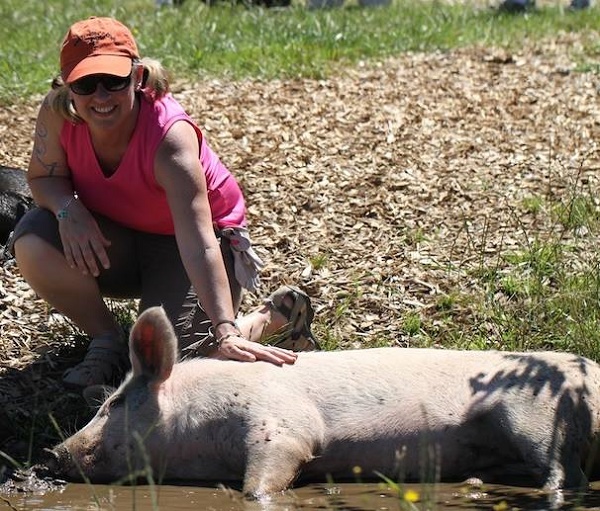
amy at pigs peace 2012

At Pigs Peace, Stanwood, WA (2012)

Why did you choose to be vegan?
My compassion for animals started early but I attribute my determination to speak up on their behalf to the tragic story about my first dog companion. When I was a kid my family had a dog named Jeffy who was not allowed in the house. Jeffy was chained in our backyard 24/7 and I don’t remember Jeffy ever being off that chain. After Jeffy bit a neighbor kid so badly he was sent to the hospital for multiple wounds, Jeffy was taken by animal control and euthanized. I remember that day clearly, as the attack happened during my younger brother’s birthday party while we all watched in horror. Naive to the true cause behind the chained dog’s aggression, I blamed the injured kid for being the reason my dog was taken. Thankfully my family has evolved and we are all compassionate dog guardians today, but Jeffy has always stayed with me. I don’t have any photos of Jeffy or fun memories with him at the park. He never got to snuggle with us under the covers on stormy nights or play fetch on sunny days. He deserved so much better and I think I knew that even as a kid. I believe that’s where my drive to help animals started, with sweet Jeffy.

From there I grew as an animal advocate, always the girl who loved animals. I became a vegetarian when I was 19 on a challenge to try it for a week (and never looked back!). While my veganism is the accomplishment I’m most proud of, I’m embarrassed to admit that it took me 13 years as a vegetarian before finally going vegan. I knew in my heart it was the right thing to do, but it took working for PETA and seeing what happens to cows for our dairy products, to open my eyes.

As my bond with animals continued to strengthen, my voice defending them became louder.
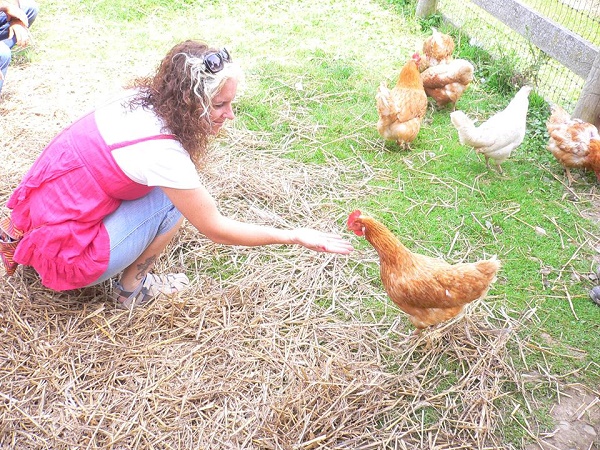
amy at farm sanctuary NY 2009

At Farm Sanctuary, Watkins Glen, NY (2009)

Biggest challenge:
When I first went vegan, like many others, my biggest challenge was giving up cheese. Now that I haven’t had animal cheese for over 10 years it seems strange to think that I ever craved it so badly. Cheese is addictive and so prevalent in our society that as an American Vegetarian my diet was 90% cheese.

These days, as an experienced and confident vegan, my biggest challenge is dealing with others around me. The food part is easy. So is avoiding animal products and entertainment. Being vegan is as much a part of my life as having two hands is. But—handling the misguided masses whose reactions range from curious questions to disrespectful teasing and ignorant confrontations is exhausting and at times disheartening. As much as we’d like to, most vegans don’t live in a bubble or in a commune filled with kind, like-minded peace promoters. Even in Seattle—one of the most progressive cities in America—we are painfully reminded of animal cruelty by way of unapologetic associates eating animal flesh at our table, leather shoes worn by otherwise compassionate friends, the baffling celebration of animals imprisoned in zoos, cheap hamburger ads (seemingly everywhere!), and predictable wild-animal-killed-by-authorities-after-hiker/boater/camper/surfer-strays-too-close-and-is-bitten news. It’s a lot to handle when your eyes are open to the suffering.

Best reward:
So glad you asked, it was getting a bit grim there. There are many rewards for being vegan! For me, the biggest reward comes from within. At the end of the day, I know I am making a difference for animals. Just in eating exclusively vegan I spare about 200 animals a year from unimaginable pain and suffering. Additionally, my ethically-minded consumerism spares countless animals from misery in testing laboratories, performance training, egg production, slaughterhouses, puppy mills, dairy factories, and skin and fur production. That feels really good. Knowing that makes me happy, fills my spirit, and drives me.

Being vegan has also led me to try many delicious diverse and ethnically varied foods. As a kid my blue-collar-Midwest upbringing kept my plate limited to a pretty dull repetition of the same gravy-covered, nutrient-deficient meals. As a vegan, I am continuously trying new flavors and expanding my favorite dishes. I’ve become a creative cook, and not just because I need food to survive, but because I get real joy from crafting new cuisines with a growing assortment of fresh ingredients and spices. I love to eat (a little too much sometimes) and have fun trying new things (but still hate cooked carrots).

Oh and I can’t forget the cancer. When I was diagnosed a year and a half ago with stage 3 breast cancer, I was told by two different doctors that if it weren’t for my vegan diet, my cancer would have been worse. You can read my blog (www.rainydayvegan.com) to follow my progression through cancer treatment as a vegan.

Are you involved in AR, vegan outreach, etc.?
Yes, I’ve been active in helping animals in many capacities for more than 20 years. I remember attending my first animal rights meeting in Toledo, Ohio. When I left, I felt exhilarated and inspired! Even though we were a small group, it was somewhat of a spiritual experience to talk openly with others who saw what our society does to animals and agreed that not only is it not okay and worked tirelessly to stop it. From then on, I’ve been an active advocate of animals by bringing awareness of their suffering to others any way I can. Animal activism is my primary hobby and my proudest attribute.

In my tenure as an activist I’ve worked in several animal-saving jobs and volunteered with many animal-helping organizations—wildlife rehabilitation centers, veterinary clinics, PETA, ASPCA, vegan advocacy groups, and animal shelters. I’ve attended thousands (give or take) of protests and have been arrested twice for civil disobedience, chaining myself to others in remonstration of the fur industry and sales.

amy protesting fur at Nieman Marcus in Toledo OH 1999

Protesting fur sales at Nieman Marcus in Toledo, OH (1999)

Today my voice is also heard through my work with a local animal welfare organization that annually helps thousands of dogs, cats, and wildlife in the Pacific Northwest through foster care, sheltering, spay/neuter, adoption, community education (my job!), and rehabilitation.

amy working for PETA's local field division community animal project 2011

Working for PETA’s community animal project (2011)

I continually strive to do more for animals. When it seems overwhelming, I’m fortunate enough to be surrounded by an amazing community of vegan activists who get it. My closest friends are those fighting along next to me one day, and commiserating with me over vegan mac and cheese the next. I gain strength from my fellow activist comrades and couldn’t do what I do without them.
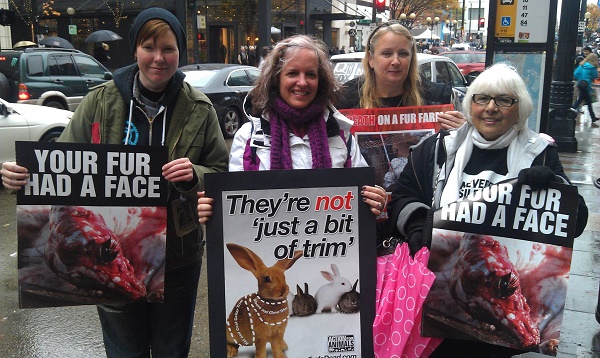
amy at fur free friday 2012

At a Fur-Free Friday demo with Jes Cochran, Franziska and Claudine (2012)

Advice for new vegans:
Remember that you are the only person that decides what you eat, wear, allow, and spend money on. It may seem daunting to remember to read labels and ask about ingredients. You’ll make mistakes, we all have. But embracing a vegan lifestyle is the most satisfying and important decision you’ll make. Every bite you take, shoe you wear, pillow you sleep on, and performance you attend that doesn’t support animal suffering, is an exercise in your strength. You are going to love being vegan!

Parting words:
The planet is suffering and she needs us all to help. With each choice we make, we all hold the power to make the world better. This may sound cliché (we’re all friends here, right?), but, go vegan!

~

Thanks for the touching stories and motivating ideas, Amy, and for all you do for the animals!

To contribute to this feature, check out the profile intro page and drop me a line.

Unknown's avatar

Help send Watoto to a sanctuary–not another zoo

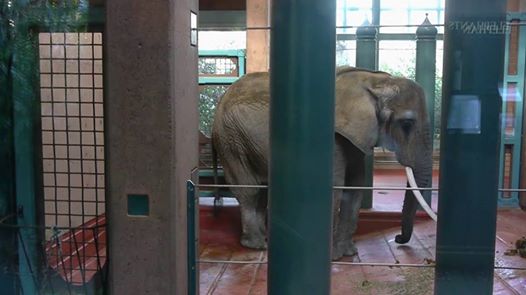
Watoto is one of the three elephants–and the only African elephant–at Seattle’s Woodland Park Zoo. Over forty years ago, as an infant in Kenya, she was captured, torn away from her mother and family, and brought to the US.

watoto

So today, about 70 people, organized by Friends of Woodland Park Zoo Elephants, filed into the Seattle City Council meeting to represent Watoto and ask that the council send her to a sanctuary.

All elephants at the Woodland Park Zoo (the others being Bamboo and Chai) languish in a small enclosure–about an acre in size. That acre is subdivided to keep Watoto apart from the other elephants (they don’t get along). And for over half the year, because of Seattle’s cold, damp climate, the elephants spend 16-17 hours a day indoors.

For large, migratory animals used to traveling great distances, this is a cruel arrangement.

Friends of Woodland Park Zoo Elephants is working hard to have the three elephants retired to a sanctuary. However, Watoto’s situation is urgent: The zoo intends to send her to a different, impoverished zoo!

Watoto is lame, broken and aging. She deserves to live out her days at a place like PAWS or The Elephant Sanctuary.

The Council didn’t let us speak up for Watoto, but our presence–and our shirts–spoke volumes. We will try again. Watoto depends on us.

How to Help

Please take a few minutes to email the Seattle City Council and Mayor Ed Murray. Simply say, “Send Watoto to a Sanctuary” or include these points:

  • A super majority of citizens want the elephants retired to a sanctuary.
  • Since the zoo is moving Watoto, we’re asking that the Zoo honor our values and send her to a sanctuary.
  • Studies have shown that keeping elephants in zoos serves no measurable conservation or educational purpose.
  • Woodland Park Zoo has received $100 million taxpayer dollars from the City and King County since 2002 making the welfare of Watoto all of our responsibility.
  • Twenty-seven zoos have closed or will close their elephant exhibits; let us join those progressive enlightened Zoos.

Email: Ed.murray@seattle.gov, Jean.Godden@seattle.gov, Sally.Bagshaw@seattle.gov, Tim.Burgess@seattle.gov, Sally.Clark@seattle.gov,  Bruce.Harrell@seattle.gov, Nick.Licata@seattle.gov, Tom.Rasmussen@seattle.gov, Mike.OBrien@seattle.gov, Kshama.Sawant@seattle.gov, Deborah.jensen@zoo.org, Bruce.Bohmke@zoo.org, Darin.Collins@zoo.org, nancy.hawkes@zoo.org, zooinfo@zoo.org

Tweet: @Mayor_Ed_Murray   @SeattleCouncil   @woodlandparkzoo

~

July 14/2014 update

We made the news this evening!

August 23rd update

Watoto was found dead in her cage. RIP Watoto. This tragedy highlights how unsuited elephants are for zoos and reinforces the importance of sanctuary.

Unknown's avatar

Inspiring action

I recently watched an interesting Ted Talk by Simon Sinek called How Great Leaders Inspire Action. The talk focused on such diverse leaders as the Apple computer company, Martin Luther King Jr., and aviation pioneers the Wright Brothers.

In the talk, Sinek said all great inspiring leaders–from business to social justice–think and act the same way. That is, the opposite to everyone else.

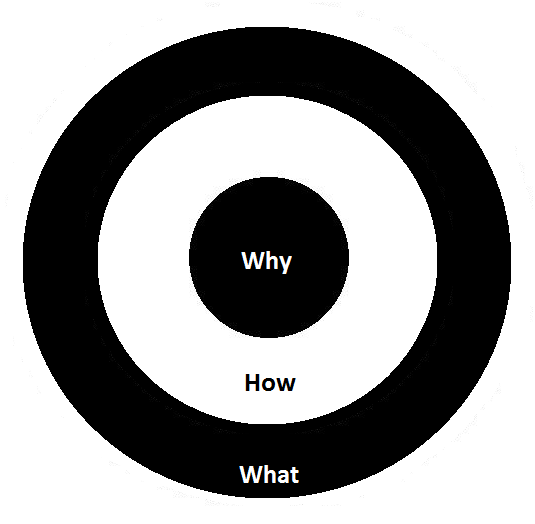
Sinek described what he calls The Golden Circle: Why, How, and what.

the golden circle

We all know what we do. Some people know how they do it, and very few people or organizations know why they do something.

Why is the purpose, cause or beliefs that we have. It’s the reason we get up in the morning and do what we do. Most people work from the outside in. But the inspired leaders work from the inside–from the why.

Working from the inside out also means we work using feelings and emotions first rather than analytical thinking.

As I listened, I couldn’t help think of the parallels between being a great leader and being a vegan. If you act based on what your soul tells you, you’re probably working from the inside out. If the stories of factory farmed animals tug at your heartstrings more than stats about the number of animals who suffer, you’re operating from the why.

Like leaders, vegans pursue something we believe in. And by doing so we can help others buy into the why and believe what we believe.

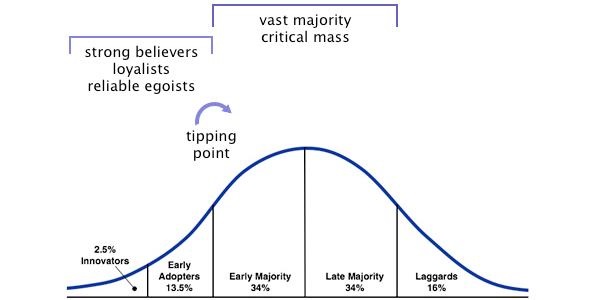
Sinek spoke about the Law of Diffusion of Innovation. A new term, perhaps, but you’ll recognize the concept.

law of diffusion of innovation

2.5% of people are innovators; 13.5% are early adopters; 34% are the early majority; 34% are the late majority; 16% are laggards.

If you want mass market success or acceptance of an idea, you can’t reach it until you reach the tipping point–between 15% and 18% market penetration. The early majority won’t try something until someone else has tried it first.

If you’re a vegan, you’re an innovator. You go against the grain and are comfortable making gut decisions and you’re driven by what you believe about the world.

Numbers vary, but about 2.5% of Americans are vegan (innovators). In our daily lives, we reach many people with our message–whether it’s overt leafleting and tabling or subtler ways of leading by example.

The vegan population is growing. What’s exciting to me is that as soon as the early adopters are on board and we reach the tipping point, the early majority will join in as well. From that point, veganism will snowball. This model applies to business models as well as social justice movements like civil rights.

People don’t buy what you do, they buy why you do it. What vegans do is the proof of why we believe. And if others learn about veganism and believe being vegan is the best way to stop cruelty, feed the world, stay healthy, and save the environment, they’ll be vegan too. But they won’t do it because you are vegan. They’ll do it because they believe it’s right. They’ll do it for themselves.

You don’t need to be a leader to lead. You don’t need to hold a position of authority to inspire others. Others will follow those who lead because they want to, not because they have to. Those who start with why will inspire others and find others who inspire them.

The talk wasn’t about veganism but it’s a perfect fit. To listen to the presentation (it’s a quick 18 minutes), check out the Ted Talk link.

Unknown's avatar

Vegan profile #3: Fernando Cuenca

Name: Fernando Cuenca
Age: 35
Occupation: Engineer

How long have you been vegan? Around 14 years

Fernando

Why did you choose to be vegan?

To me veganism is the extension of the struggle for justice to non-human animals. For the vast majority of people the need (not desire) to consume animal products is non-existent. That unnecessary killing is unjust. I was first introduced to the concept of veganism through a hardcore band called Earth Crisis, but never considered a viable choice until I started attending anti-bullfighting protests in my hometown. Once I had that aha moment, I never went back.

Biggest challenge:

Two things. First, eggs. Not actually craving eggs, but the fact that they are in so many things that you really need to be careful to avoid them. Second, going vegan in two different languages. When I first went vegan I was back in Colombia, where I am from, and had to learn a lot of new terms regarding animal ingredients. When I moved to the US it was almost like going vegan again. It was a lot of new words that didn’t tell me anything about their origin (whey for example, which in Spanish is proteína de leche – protein from milk). I had to spend long hours at the supermarket reading labels with the help of an animal ingredients list.

Best reward:

My family and friends. My wife is also vegan (we are a Veggiedate success story) and we have a 4-year-old son that has been vegan since birth. I also have friends who in the beginning didn’t understand why I chose this lifestyle and when they expressed interest I gave them information that made them go vegan themselves. They have gone on to be outspoken about animal rights, start their own vegan families and raise vegan children. It gives me a lot of satisfaction to know that our impact will spread beyond our own lifespans.

Are you involved in animal rights, vegan outreach, or other types of activism or education?

In Colombia I used to run a vegan outreach group with some of my friends called Verdadera Compasión (True Compassion). Since moving to the US I have done volunteer work for PETA, also been involved in Farm Sanctuary’s Walk for Farm Animals (first in New York City, now in Seattle). I currently volunteer for NARN and with my wife we run a Meetup group called Seattle Area Vegan and Vegetarian Families.

Advice for new vegans:

Don’t let it overwhelm you. I think that in every vegan journey there’s a point in which you see that animal exploitation and abuse is pretty widespread. At that point it is very easy to get depressed, to feel that your efforts are worthless, not making any difference. But push through it, see the positive in what you do. Enjoy the fact that you can look at an animal in peace, visit a sanctuary if you can (there are quite a few around Seattle). Tell someone or get involved, it may change their lives and the lives of countless animals forever.

Parting words:

If you are vegan, the animals thank you! If you are not, please consider it, it will be one of the most impactful decisions you will ever make.

~

Thanks Fernando–for agreeing to the interview and for all you do for the animals!

To contribute to this feature, check out the profile intro page and drop me a line.

Unknown's avatar

Touring the Field Roast HQ

I love the vegan options in Seattle. In addition to tons of vegan restaurants, we’ve got a vegan grocery store, and a thriving group of activists.

Well, did you know that Field Roast is a Seattle company? It is, and I visited their new location in Seattle’s SODO neighborhood for an open house and BBQ.

Field Roast HQ

Field Roast prides itself on making great products using grain meat. Grain meat got its start in 7th Century China. Seattle chef David Lee honed his recipes using barley, wheat and oats and adding a more European flavor to his foods. Foods like sausages, roasts, deli slices and burgers.

The tour was fantastic (no photos were allowed inside though). I arrived at the same time as a few other friends so we walked through the facilities together. I bet you wouldn’t enjoy seeing the inside of a typical sausage factory. But Field Roast is different; it was more like a bakery. We saw an immaculate series of rooms with industrial equipment like mixers and ovens. It smelled like all the wonderful spices in the Field Roast products.

We saw how the food is cooked, packaged and frozen for shipping. We toured the warehouse, test kitchen, and offices. I especially liked the sports wall–look at all the stadiums that carry Field Roast products!

sports wall of fame

Then, we were treated to an all-vegan BBQ!

Field Roast BBQ

I use Field Roast products a lot. I’ve blogged about how their sausages are great for making traditional recipes vegan. And their soft herbed cheese will win over omnivores every time. When I eat at Blue Star Café and the Georgetown Liquor Company, I order items made with Field Roast. Even the cafeteria at my work offers Field Roast!

Field Roast burger

After eating my delicious burger (like the one pictured above–that was one I had at Blue Star), the Seattle Cookie Counter arrived to give us dessert. Their a brand new vegan ice cream sandwich company that sells delectable treats out of a vintage VW bus!

cookie counter vegan ice cream sandwich

I’m so grateful to have had a chance to see how Field Roast is made. I’m especially pleased to support a local, vegan company (they employ 65 people) that is ethical and progressive. Barbecuing might be an American pastime, but Field Roast will help make All-American Vegetarian the new way to think about BBQs.

Have you tried Field Roast products?


Unknown's avatar

Vegan profile #2: Luke Jones

Name: Luke Jones
Age: 22
Occupation: I’m a blogger at my site Health Room, where I explore and share ideas in plant-based nutrition, moving freely, living mindfully, and existing sustainably. I write a little for Mind Body Green and Natural News too. I have also just published my first eBook about plant-based nutrition, so I guess you could say I’m an author now as well, which sounds a bit surreal to me…

Handstand Luke

How long have you been vegan?

I first tried the vegan diet a few years ago in 2012. I initially did it for 6 months, then switched to a more of a paleo type diet for a couple months, just to see how that made me feel. I definitely preferred the vegan diet for a number of reasons, so changed back to that, and I haven’t looked back since!

Why did you choose to be vegan?

I’ve had a few health problems since my late teens, and they worsened whilst at university. I would get run down a lot of the time, with mouth ulcers and stomach issues. It wasn’t too fun!

So I initially turned towards the plant-based diet to help with these health problems, after reading about it on the web and listening to Rich Roll on the Joe Rogan Experience Podcast. And I can definitely say that the change in diet has helped significantly.

I also noticed that it improved my athletic performance. I’ve always been really active, and love martial arts, bodyweight strength training, climbing, football, yoga… All sorts of things. I feel that this diet lets me perform better for longer, and helps me recover quicker.

And aside from the benefits to me personally, there are also those wider impacts on the planet and the other species we share our home with. It’s staggering how much energy, land and water is needed to sustain the standard western diet. Being vegan significantly reduces the impact we’re having on the planet, and I think that’s great.

Then there’s also the ethical benefits, which are becoming increasingly important to me. I’m thriving on a plant-based diet, and I can’t justify taking a life when I don’t need to. I think everyone is naturally compassionate, and no one wants to cause unnecessary suffering, but there’s such a disconnect between what goes on in the slaughter houses and what arrives on people’s plate. Most people have such strong ingrained habits that they will turn a blind eye to what’s going on. But I don’t want to be a part of that if I can help it.

Best reward:

Aside from the benefits I mentioned above, I love the fact that I can share this message with others, and help them realise their health potential. It’s always great to hear stories from readers who have taken charge of their life, maybe losing unwanted weight or curing a lifelong illness. It’s amazing the power of a few changes in diet and lifestyle.

And it’s not people just online I get to interact with. I love that I get the chance to share this experience with those closest to me – my friends, family and my beautiful girlfriend (who is also vegan). Making meals with her and sharing similar views is so awesome, I’m very lucky.

Biggest challenge:

I actually didn’t really struggle with the change to a vegan diet. I had been interested in nutrition for a few years prior, so had already cut out dairy, reduced the amount of processed foods, and upped my fruit and veggie intake. So the transition was pretty smooth. I also knew that it would benefit my health massively, and the thought of that was much stronger than any cravings for chicken.

The only challenge now I think is seeing so many people who are basically poisoning themselves and their children with unhealthy foods, often because no one has told them otherwise. It’s quite difficult to watch that happen all around you, every day. But I do still feel optimistic for the future!

Favourite vegan food:

You can’t beat some ripe bananas and juicy medjool dates. In terms of cooked meals though, it’s a tie between homemade Mexican burritos and homemade Indian food. I’m getting hungry now…

Are you involved in animal rights, vegan outreach, or other types of activism or education?

I’m not involved in any activism as such, but I try my best to share the positive message and educate others via my site, Health Room.

I try my best to present the information in an accessible way and avoid preaching. I wanna help people, but I think there’s a fine line between educating and forcing our views on others. Sometimes it can be hard to find that balance.

I don’t ever want to tell people what they have to do. So I try to share what has worked for me, and then let the readers make their own decisions. Take what resonates with them and throw away the rest.

Advice for new vegans:

Firstly, thanks for making the decision to try a vegan diet! It could be the best thing you ever do for your health, and for the planet.

Secondly, don’t be afraid to make the transition slowly. Go at your own pace, maybe cut out dairy first, then cut out meat when you feel comfortable. Do what you need to do to make your changes sustainable.

Finally, try your best to eat mainly whole foods. Fruits, veggies, legumes, whole-grains, nuts and seeds. Being vegan is great, but being a healthy vegan is even better. And don’t be afraid to ask for help. There are plenty of people out there willing to give a hand, me included 🙂

Parting words:

Eat more plants. Move your body. Laugh, smile and help others. Go after your dreams. Don’t leave a trace. And create more than you consume.

Thanks Jean for the opportunity, and keep up the great work!

~

Thank you, Luke! Your profile is inspiring!

Interested in having your profile featured? Check out the profile intro page and contact me!

Unknown's avatar

Vegan travel tips

Sometimes, TWV (traveling while vegan) is easy. In New York City, there was no shortage of vegan restaurants (Candle 79, the Chelsea neighborhood, and Williamsburg area of Brooklyn are examples). Savannah, Georgia was a bit harder, but far from impossible.

I’ve travelled to Costa Rica and Vancouver, and lots of places in between–and I’ve always found vegan food. As summer travel heats up, I thought I’d share some travel tips with you:

Book it

Flying? When you book your flight, don’t forget to request a vegan meal. On short flights, or when food is sold à la carte, see the next tip, wich is:

Pack snacks

In order to eat healthy and never be famished, I pack snacks for the plane and for the trip. I’m never without a Luna bar (or 5) and a bag of almonds. They keep me energized between meals, and on the off-chance I can’t find more than a flimsy salad to eat, I get by with what I pack.

Research

Veg Dining and Happy Cow are great resources. You can even download their apps for your smartphone so you’ll never be left wondering. Look up the city or country you’ll be traveling to and plan to visit vegan, vegetarian, or veg-friendly restaurants.

Shop

I generally don’t eat out three times a day when I’m on vacation. I look for farmers markets and grocery stores so I can stock up on nibbles like hummus and carrots, fresh fruit, soy yogurt and other healthy foods. Most will fit in a hotel room mini fridge so you have something to turn to throughout your stay. Camping? The world is your oyster (just don’t eat the oyster!). Veggie dogs, instant oatmeal, and vegan marshmallows will keep you happy.

Ask

I prefer to support vegan restaurants, but I’ve found vegan meals in the least likely of places. Even meat-centric restaurants will assemble a special meal upon request. I’m always polite, grateful, and tip accordingly. I’ve found that people are usually happy to accommodate my requests.

Network

Between friends and social media (FB, Yelp, web searches for vegan resources in the place you’re visiting), I get a lot of tips and suggestions.

Suitcase_by_Linda Bailey

Armed with these tips, you’ll be ready for your vacation. Do you have any other ideas for a smooth vegan holiday?


Unknown's avatar

Vegan profile #1: Carmen Coburn


This is the first in a series of vegan profiles I’m sharing on my blog. To contribute to this feature, check out the profile intro page.

Name: Carmen Coburn
Age: 62
Occupation: Dance instructor

mom at Ribfest

Carmen Coburn (holding sign) at a Ribfest in Ontario

How long have you been vegan? Ten years

Why did you choose to be vegan? My daughter Jean (editor’s note: that’s me!) gave me a book Diet for a New America and I found out the cruelty inflicted on animals, particularly cows and hens.

Biggest challenge: Giving up cheese and yogurt, which I ate on a daily basis because I didn’t think my vegetarian lifestyle harmed animals.

Best reward: Peace in my heart, knowing that I don’t contribute to the misery of farm animals (or any animals). Health.

Are you involved in animal rights, vegan outreach, or other types of activism or education? Yes, I have helped organize Animal Rights Day in the city where I live, I marched in Toronto for animals, I bear witness to the tortuous treatment of pigs before they are slaughtered in a nearby slaughterhouse. It breaks my heart.

Mom at march

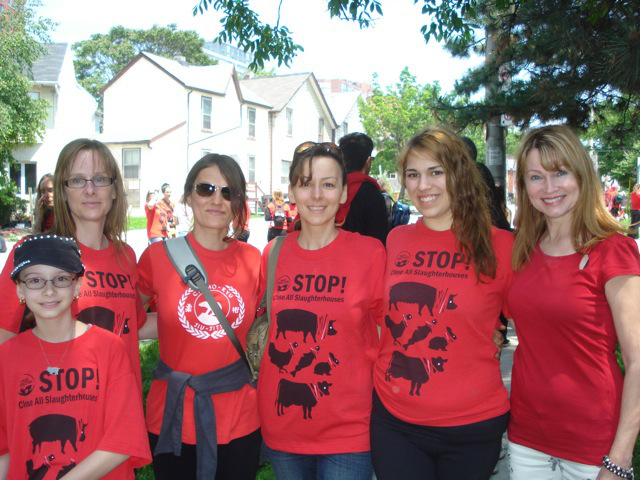
Carmen Coburn (right) at the Toronto March to Close all Slaughterhouses

Advice for new vegans: Find like-minded people; eat a healthy, plant-based diet.

Parting words: Go vegan: for health, for the animals, for our environment. It’s a win win win situation!

mom at a slaughterhouse

Carmen (right) and friend, bearing witness at a slaughterhouse

Thank you, Carmen (Mom!), for all you do for the animals and for being such an inspiration and vocal proponent for animal rights and veganism! And thanks for being the first vegan profile on my blog!

Be sure to check out Carmen’s blog, Fashionable Over 50, where she shows how to be a healthy and stylish vegan.

Unknown's avatar

Vegan profiles

Ever since I started this blog, I’ve wanted to use it to share other vegans’ stories with the world. I’m finally doing so with a feature I call Vegan Profiles.

tulip

I’d like to showcase a variety of vegans in this feature because I want to break stereotypes and give people role models. We’re all different and we all have different tales to tell. Hopefully some resonate with you.

Like a tulip in the grass, I know you stand out. You’re unique; you’re interesting; you’re vegan!

If you’d like your profile to be considered for this feature, contact me. I’d love to hear from you.

To be included, I’ll I ask is that you follow a vegan lifestyle. I’ll include profiles that fit the nature of the blog. Drop me a line and I’ll send you the questions!