Unknown's avatar

Visiting Pigs Peace Sanctuary

Last Saturday I had the chance to visit Pigs Peace, a sanctuary for abused and neglected animals. A hundred and ninety-one pigs now call the sanctuary home. They, and a few non-pigs, will get to spend the rest of their lives in peace. Old age is something most pigs never see, so living a long life is very special.

Pigs Peace

I went to the sanctuary because Jo Lombardi, a grief counselor, was offering a healing retreat for animal rights activists. Activists are often the people who see the things that others turn away from. We see the damage that others cause, and we know the dire situation that a lot of animals are in. That can be stressful, so having a safe place to talk among like-minded people was refreshing.

Jo is switching the focus of her practice to help animal activists exclusively. What a treat! She led us on guided meditation, a way to de-stress, and gave us materials so we could create an action plan and work toward balance in our lives. We were treated to vegan chili and snacks, and got a chance to share our stories with others.

After the retreat, sanctuary founder Judy Woods took us on a tour of the sanctuary.

A pig poses

We saw a group of pot-belly pigs rescued from a hording situation, we saw pigs who’d escaped slaughter and others who’d been rescued from neglect and abuse. The biggest pigs were 900 pounds! Unfortunately humans have been breeding pigs to be bigger and bigger. In the mid-1800s, a pig on a farm usually grew to 150 pounds.

One thing that struck me is how clean the farm was. It didn’t stink. The barn smelled like fresh hay. Pigs are naturally clean animals and don’t eliminate where they sleep. The barn was a place where the pigs could pile up, nest, cover up with hay, and get cozy. They did their business elsewhere. Of course pigs can’t sweat, so on hot days, you might find them cooling off in water or mud!

three pigs

I was also surprised by how hairy the pigs were. I always pictures “pink pigs” as being hairless. Well the “pink ones” had white hair. Others were brown, black, spotted or two-tone.

Pigs are smart! Smarter than dogs. They’re funny, playful, responsive, inquisitive, and a joy to watch.

We got to throw pumpkins to the pigs. They came running through the fields from all directions when Judy called them. And within a few minutes, two wheelbarrows full of pumpkins were gone!

pumpkins

Next up: Carrots. Judy rang the dinner bell and the pigs ran to the cement feeding area that we were busy littering with carrots. One again, the pigs ate them all–all 100 pounds of carrots!

carrots

One pig, a beautiful gray spotted one, would gather up as many carrots as she could. She walked far away, carrots spilling from her mouth the whole way, and then ate her “stash.” None of the other pigs did that, but she preferred to eat “buffet-style.”

spotted pig

If you ever get a chance to visit Pig Peace, I encourage you to. If you can’t get there, visit their website and look at all the pigs and read their stories. Judging by the amount we fed them, I’m guessing it’s not cheap to run a pig sanctuary. Pigs Peace is a 501(c)3 charitable organization, so consider making a donation.

In case it’s not obvious by now, I want to remind people that pigs are beautiful creatures who don’t belong on a dinner plate. I’m so sick of the cult of bacon. Bacon, pork chops, sausage–they’re all the same. It’s the flesh of a pig. And pigs deserve better than this. They deserve peace too!

And now for your viewing pleasure: pigs!

Unknown's avatar

Giving livestock isn’t charitable

Imagine, if you will, that you live in an impoverished community in an underdeveloped nation. Your one-room hut has a dirt floor without electricity or running water. You have to a make a fire just so you can cook. Food is scarce but you do your best to feed your children.

Then a western charity gives you a cow (or goat, or maybe a flock of chickens) so you can use this animal to improve your life. Sounds good, right?

Not so fast.

Ever raised a cow? Tried predator-proofing a chicken coop? Taking care of animals is hard to do. It’s a real burden, especially for people trying to raise a family and meet their basic needs.

cow in Africa

Livestock costs a lot. Animals get sick and require vet care, they drink a lot of water (water that might not be easily accessible), and they eat food that could be used to feed people. Animals eat more than they produce. Often the price of food for livestock is greater than the money families can get from selling milk or meat.

The chances of the animals getting good care (when people can’t give their families proper care) are slim. Sometimes animals are used as currency and are bartered away. Other times children are pulled out of school to tend to the animals.

Oxfam-funded drinking hole in East Africa

Eating high on the food chain isn’t wise. But western charities promoting western lifestyles and diets, would make you think it’s ideal. By introducing western eating habits, they’re introducing western diseases. The majority of people in countries where livestock is gifted are lactose intolerant anyway, so what good is a dairy cow?

The environmental costs of bringing more animals into a region are high too. Water pollution and waste runoff is one issue; desertization of land is another. Raising animals for food is a bigger contributor to global warming than all forms of transportation combined.

As a vegan, I care about animals. That’s why I can’t give money to charities that promote the mistreatment and slaughter of animals. I also care about people, which is why I don’t support charities that promote meat as an optimal food.

This holiday season, when you’re looking for ways to help others, look for organizations that promote ethical, sustainable ways to invest in communities. Here are a few:

Alternatives

  • Vegfam – Self-supporting, sustainable, plant-based food programs, and water resources.
  • Trees for Life – Fruit trees, books, education, clean water, and fuel-efficient stoves.
  • Plenty – Plant-based nutrition, healthcare, education, self-sufficiency, and disaster relief.
  • A Well-Fed World – Plant-based nutrition, education, farm animal rescue, and food sharing.
  • Kiva – Micro-loans for people to start small businesses and get themselves out of poverty.
  • SALEM – Education, shelter, environmental protection, nutrition information, and vegetarian meals.

Further reading

Unknown's avatar

Down with feathers

It’s fall. The weather is cooling off, and you want to get cozy. Dreaming of curling up under a down comforter? Thinking of sporting a down-filled jacket or vest? Think again.

Feathers in clothing or bedding are an oft-forgotten animal product. Many people don’t think about the way down and feathers from ducks, geese and chickens are harvested. Often, they’re slaughterhouse byproducts–and profitable ones! Sometimes, they’re even plucked from still-living birds.ducks

Not all countries live-pluck birds, but Hungary and China are two that do. Plucking is painful for the birds, who often undergo the process many times. Egg-laying geese must endure being plucked 5-15 times in their short lives–before they’re sent to slaughter. Geese raised for meat are killed much younger and are plucked about 4 times.

Birds are raised in crowded conditions and when it’s their turn for plucking, they’re caught and held down. The forceful plucking leaves their exposed skin raw, bruised and bloody. I can’t imagine someone yanking out the hair on my head, but that’s what it must feel like.

Even ostriches suffer from plucking. Their feathers are used for decorations, feather dusters, and boas. And roosters are raised and killed for so-called fashionable hair accessories–I’ll write a separate post about that soon.

Money from the sale of down and feathers lines the pockets of foie gras producers and companies that confine birds for their eggs and kill them for their meat. They’re not simply a byproduct.

Alternatives:

Fortunately, synthetic options are available–and they’re superior to down! So next time you’re looking for a sleeping bag, comforter or parka, make sure to avoid ones made with real feathers. Primaloft, Thermal R and Omni-Heat are examples of high-tech, synthetic materials that trap in heat and keep you warm. image of woman in pink parka c/o Vaute Couture

Patagonia, Marmot, Columbia and Northface are just some brands that carry coats made of those materials. But be sure to check the labels–not all the coats they carry are down-free. That’s why I particularly love Vaute Couture, an all-vegan fashion house with really warm wool- and down-free coats.

Most departments stores and specialty shops carry a variety of comforters. Ask for a synthetic option or check the labels before you buy so you–and the birds–can rest well.

Resources:

Unknown's avatar

The circus is in town

Last weekend, the Northwest Animal Rights Network held peaceful demonstrations in Kent, WA, the Ringling Bros. and Barnum & Bailey Circus. This weekend, we’ll be doing the same thing in Everett.

kent circus

This style of circus reeks of colonialism and is a throwback to Victorian times, when swindlers like Ringling, Barnum, and Bailey first got started. P.T Barnum was a money-grubbing showman who’s known for saying “there’s a sucker born every minute.” He promoted blackface minstrel shows and got away with exploiting animals, women, minorities, little people, people with health issues, and anyone else he could make a buck off.

These days at Ringling, only the animals are allowed to suffer.

Ringling will tell you (as they do on their site) that they provide excellent care for their animals and that the animals are ambassadors for their wild counterparts. However, there’s no denying that Ringling had to pay the largest fine for animal abuse in US history ($270,000) for violations of the Animal Welfare Act.

Ringling commercial

No matter how the animals are treated, here’s one thing I stand by: Wild animals don’t belong in circuses. They’re not here for our amusement. They don’t deserve to be caged and carted around, forced to perform 11 months a year, and beaten into submission (that’s essentially how one “trains” an elephant).

Seeing an elephant balance on her hind legs teaches me nothing about how they behave in the wild. I guarantee that bears don’t want to ride bikes, and tigers never line up to jump through fiery hoops. Circuses are bad for animals, and not safe for spectators.

If the circus comes to your town, find something else to do. I can think of at least 10 ideas:

  • Spend the day riding roller coasters
  • Ride your bike, go for a hike, or fly a kite
  • Two words: Go carts!
  • Catch that blockbuster film you’ve been wanting to see
  • Visit an animal sanctuary
  • Go to the beach
  • Attend a sporting event
  • See your favorite band in concert (or check out the symphony)
  • Spend the day at a flea market or craft fair
  • Take a cooking class
  • Go kayaking (or swimming–if you fall out)

Or, go to a circus–a circus that doesn’t exploit animals! Cirque du Soleil and other acrobatic, theatrical shows are exciting and showcase very talented humans–who aren’t enslaved, and actually like what they do!

What are you going to do instead of going to a circus with animals?

Unknown's avatar

Why Paleo diets belong in the Stone Age

The Paleolithic, or Caveman, diet has gotten a lot of press lately. It sounds similar to the Atkins diet of a few years ago (remember that?) with a few more fruits and veggies added in. Many proponents claim eating like early man is how we’re designed: Lots of lean meats (especially wild game) and no grains is what the doctor ordered. Or is it?

First the positives: The Paleo diet encourages people to avoid dairy and processed foods. Sounds healthy enough. But with about half its calories coming from animal protein, it’s not a wise option.

Making assumptions

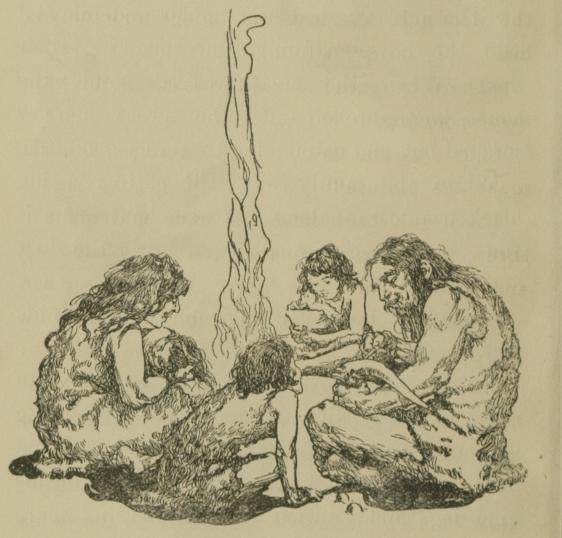
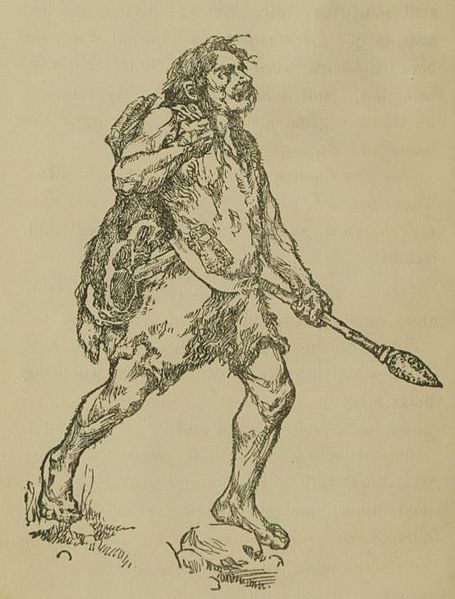
Paleo assumes early humans were mostly hunter, partly gatherer. Women (the gatherers) get little credit and macho hunting men become responsible for catapulting cavemen into civilization. Hunting without modern weapons is difficult and gathering was likely a big part of their diet.cavemen

If early humans were opportunistic hunter-gatherers, doing what they could to survive, they’d surely eat all parts of the animal. No one I know salivates over boar’s eyeballs or deer hearts (but maybe I just don’t know the right people).

The diet also assumes that eating this way was the best choice; it might have been the only choice. And was it healthy? They probably wouldn’t didn’t live long enough to develop heart disease anyway. Back then, life was brutal–and short.

Ignoring what we know

Research about our ancestors is revealing that they were mostly plant-eater, with a bit of opportunistic meat-eating (including cannibalism) thrown in. Leaves, fruit, wood and bark likely made up the biggest portion of their diets.

We also know that diets high in animal protein are unhealthy. And when we cut out carbs, we tend to add in fat. On the contrary, a whole-foods, plant-based diet can give us the most nutrients, antioxidants and fiber, while avoiding cholesterol and saturated fat.

Using diet as an excuse

CavemanAdopting a Paleo diet is a great way to say “I need bacon” and “this burger is the best thing for my body.” It gives people the green light to continue bad habits. I know a few people who eat Paleo, and none of them remember that coffee and alcohol is off-limits too. When it’s convenient, Paleo suits them fine, but the rules get broken.

Funny how people embrace the Paleo diet but also accept modern medicine, technology, and other luxuries. To be Paleo, shouldn’t we eschew antibiotics, anesthetics, dentistry, cars, computers, and central heating? Why is only the food of early humans valued, and not the rest of their simple lifestyles?

Flipping off the environment

I like that the Paleo diet steers people away from factory-farmed meats, but free-range, grass-fed meat is a luxury afforded to the affluent. Plus, we’d need an whole other planet for livestock if we wanted to raise all farmed animals in grassy plains.

Regardless of where animals are sourced, raising them requires vast amounts of water and fossil fuels. Not to mention the enormous piles of feces they produce. The meat industry is a bigger polluter than all transportation combined. Paleo, by encouraging people to increase their meat consumption, is contributing to the destruction of our planet.

Alternatives

From The China Study to PCRM, evidence points to whole-food, plant-based diets as superior to diets that include animal products. Animal-free diets are better for us (reducing risks of heart disease, stroke type 2 diabetes, many cancers, as well as obesity), they’re better for the environment, and they’re much better for animals.

Maybe it’s time to evolve.

Resources

Unknown's avatar

Unglamour shots: Posing with baby animals

What’s wrong with this picture?

cougar

Five points if you said my mullet! Ten if you said the lion cub in my lap.

As a teenager in the 80s, I thought nothing of this. I was in the mall with my brother, a makeshift studio was set up in a corner of an open area, and I got to pick which baby animal I wanted to pose with.

I never thought to question the obvious: Where is this cub’s mother? Why is he being carted around from mall to mall for photos instead of being in his natural environment? Is there a danger to humans? What will happen to him when he’s too big and unruly to be cuddly?

Sadly, animals like this are still being exploited in malls, fairs, and at roadside zoos. When these babies are too big, they end up at shoddy roadside zoos, in the pet trade, in canned hunts, or killed for their meat.

The best thing you can do is never pay for a picture with a wild animal. The Humane Society has a campaign against primates, tigers, lions, and bears being used in photo sessions. These sessions with the public fuel the exotic pet trade, puts animals at risk, and endangers the public.

Please sign it and learn from my mistake. Wild animals are not stuffed toys. Whether at home or abroad, vote with your dollars and say no to animal exploitation.

Unknown's avatar

Walk for Farm Animals 2013

This past Saturday was the Seattle Walk for Farm Animals, organized by Farm Sanctuary. About 120 people raised funds for America’s largest farm animals sanctuary (although it looked like a lot more were in the walk). Together, we raised almost $11,000–just shy of our goal.

walk for farm animals

Animal advocates in the Walk for Farmed Animals (photo courtesy of Paul Litwin)

We met at Green Lake, a beautiful Seattle park with a 2.8 mile path around a lake. Despite rain in the forecast, we had a beautiful, sunny day. My friend Shelly and I got to carry the event banner! I felt like I was in a parade. The walk was a great opportunity to honor farm animals–both the ones who are rescued and the ones who’ve lost their lives because of people’s desire for animal flesh.

Several people gave us a “thumbs up” or peace sign. Many more were learning for the first time that there are people who care about all animals and who don’t want to eat them.

Barb at the poster table

Barb helped distribute posters for people to carry in the walk

When we finished the walk, the Green Lake Community Center was set up for us with a delicious, filling buffet, live music by Gary Finkelstein, and a slide show of rescued farm animals.

Many thanks to Mighty-O, Violet Sweet Shoppe, Araya’s, Veggie GrillPizza Pi, Field Roast, and all the other businesses that donated vegan eats for the hungry walkers.

I’m glad I bought raffle tickets before the walk. I ended up winning a beautiful faux leather bag by Susan Nicole! There were many other prizes too, like dog treats by Adventure Days, pet portraits by Vegan Me, and a mini vacation at Someday Farm Vegan B&B.

The walk was a wonderful time for community with like-minded people and a chance to help support a great organization. I’m looking forward to next year!

Unknown's avatar

Gearing up for Farm Sanctuary’s Walk for Farm Animals

In less than two weeks, September 21st to be exact, the 2013 Walk for Farm Animals comes to Seattle. The event is organized by Farm Sanctuary, the largest farm animal shelter in North America. Farm sanctuary’s mission is to protect farm animals from cruelty, inspire change in the way society views and treats farm animals, and promote compassionate vegan living.

Walk for Farm Animals T

That’s why I’ve joined the event and have started raising funds for the cause. The purpose of my blog isn’t to solicit money, but if you’re interested in donating to a great cause, I’d love that! Of course if you’re in the area (or in a participating city), you’ll probably have fun joining the event and raising your own pledges.

I’m walking for Mesa, a friendly hen who escaped the brutal world of cock-fighting; for Winston, a scared piglet who escaped a live market in New York City; for Mark, a lamb who was sick and headed to slaughter; and for Michael, a dairy calf who was on his way to becoming veal.

There are many other stories like the ones above, and that’s why I support Farm Sanctuary  (I even have a Farm Sanctuary credit card, so a small portion of my purchases can help animals).

Won’t you walk with me?

Unknown's avatar

Japan Dolphin Day

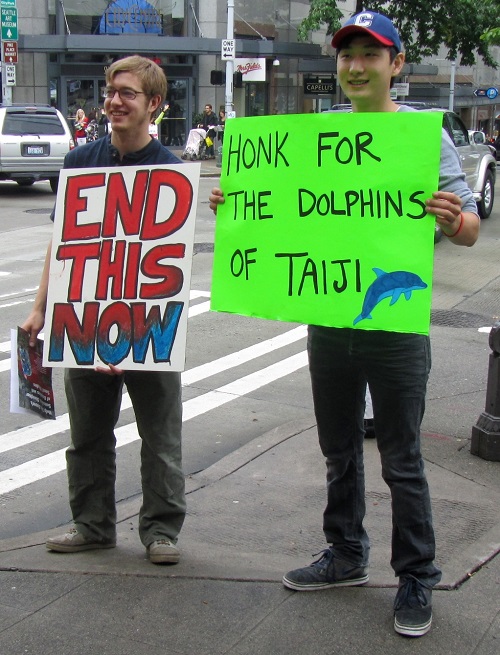
Today is Japan Dolphin Day and more than 16,000 people are joining 117 events all over the world to raise awareness of the annual dolphin hunting season that started on September 1st in Taiji, Japan.

dolphin sign

Every year, thousands of dolphins are captured and slaughtered in Taiji, by a small group of fishermen. For too long, this information was kept from the Japanese public and the rest of the world. The Oscar-winning documentary, The Cove, brought the horrors to light a few years ago.

dolphin demo

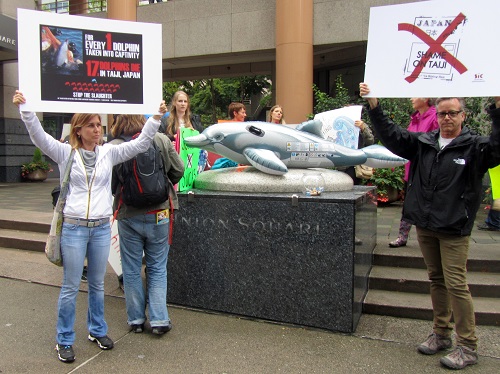
We marched from Westlake Plaza, an outdoor square in downtown Seattle, to the Japanese Consulate a few blocks away. At the consulate, we held signs for passers-by and handed out literature to raise awareness of the issue. Some people knew, others were shocked by what they learned.

dolphin slaughter protest

Dolphin meat isn’t a profitable venture, but the fishermen in Taiji can make a killing by selling live dolphins to marine parks around the world. For every performing dolphin, 17 of his friends and family are killed. Incredibly, dolphin trainers are in the boats with fishermen, picking the best candidates for marine parks. The rest are slaughtered.

protesters at Japan Dolphin Day

Dolphin meat, isn’t healthy or safe (it’s loaded with mercury and PCBs) but it’s distributed to children in the school lunch program anyway.

Japanese Consulate

The Japanese public hadn’t been aware of these atrocities until recently. Now that they know, they’re starting to do something. Brave activists from Japan and other countries are in Taiji now, protesting the slaughter. It’s especially significant that concerned Japanese are joining the efforts. Their culture doesn’t encourage speaking one’s mind, protesting in the streets, and questioning the government. But they are, and I applaud them.

Jean and Claudine

Back in Seattle, far from Taiji, we showed our support for the activists in Japan and let the Japanese government know that we do not condone this abuse of our friends of the sea.

Resources

dolphin collage

Unknown's avatar

The sad lives of carriage horses

I love New York, but one of the things I don’t like about the city that never sleeps is the carriage horse industry.

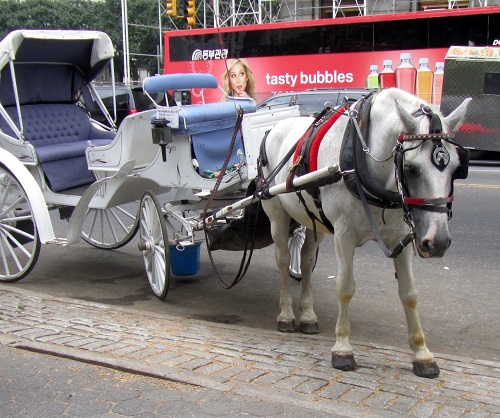
Many cities, including the one I live in (Seattle) and one I visited this spring (Savannah), offer horse-and-carriage rides. Approximately 1000-2000 horses are used across the country. These hansom cabs, might evoke an old-world feeling but they’re anything but romantic. Carriages belong in the history books.

sad horse

Horses in the carriage industry are often castoffs from the harness racing industry or from Amish communities and come to the city with pre-existing health problems. They develop further health issues from walking on pavement all day and breathing exhaust from trucks, cars and buses. They work all day in freezing cold and scorching heat and they’re stored in warehouses at night.

They’re never sent out to pasture, and have no government protection. Carriage owners are legally allowed to work their horses 9 hours a day, seven days a week–whether horses like it or not.

don't take a ride

The average working life of a carriage horse is only four years. In fact, about a third, or approximately 70, of the New York City carriage horses are eliminated from the Department of Health horse registry every year. When they’re spent, they’re usually auctioned off for slaughter or rendering plants for dog food companies or zoos.

stuck in traffic

The horses suffer and people are endangered too. Horses get spooked easily and can run into traffic. In New York there have been more than 18 accidents involving horses in the past two years. It’s a largely unregulated industry.

It’s a half-hour ride for patrons, but it’s a lifetime of misery for the horses.

Toronto, Paris, London, Las Vegas, Beijing and many other cities have already banned carriage horses. A fun horseless carriage idea is brewing that could replace horses in New York and still be fun and romantic.

In Savannah, I opted to take a pedicab ride. The man peddling told me he enjoys the job and that it’s paying for his college.

pedicabs instead

What to do?

  • Never patronize carriage rides, and tell your family and friends why they shouldn’t. From newlyweds to tourists, it’s the people paying for the rides that keep this industry in business.
  • If your city allows carriages on city streets, urge your legislators to propose legislation that will ban it.

Update (Jan 2, 2014) – New York City Mayor-elect Bill de Blasio has vowed to ban horse-drawn carriages in the city and retire the horses to sanctuaries. Money to help the horses is probably still needed and horses in other cities still need help. This promise is great news, and a good way to keep momentum going for the horses.

Resources: