Unknown's avatar

The circus is in town

Last weekend, the Northwest Animal Rights Network held peaceful demonstrations in Kent, WA, the Ringling Bros. and Barnum & Bailey Circus. This weekend, we’ll be doing the same thing in Everett.

kent circus

This style of circus reeks of colonialism and is a throwback to Victorian times, when swindlers like Ringling, Barnum, and Bailey first got started. P.T Barnum was a money-grubbing showman who’s known for saying “there’s a sucker born every minute.” He promoted blackface minstrel shows and got away with exploiting animals, women, minorities, little people, people with health issues, and anyone else he could make a buck off.

These days at Ringling, only the animals are allowed to suffer.

Ringling will tell you (as they do on their site) that they provide excellent care for their animals and that the animals are ambassadors for their wild counterparts. However, there’s no denying that Ringling had to pay the largest fine for animal abuse in US history ($270,000) for violations of the Animal Welfare Act.

Ringling commercial

No matter how the animals are treated, here’s one thing I stand by: Wild animals don’t belong in circuses. They’re not here for our amusement. They don’t deserve to be caged and carted around, forced to perform 11 months a year, and beaten into submission (that’s essentially how one “trains” an elephant).

Seeing an elephant balance on her hind legs teaches me nothing about how they behave in the wild. I guarantee that bears don’t want to ride bikes, and tigers never line up to jump through fiery hoops. Circuses are bad for animals, and not safe for spectators.

If the circus comes to your town, find something else to do. I can think of at least 10 ideas:

  • Spend the day riding roller coasters
  • Ride your bike, go for a hike, or fly a kite
  • Two words: Go carts!
  • Catch that blockbuster film you’ve been wanting to see
  • Visit an animal sanctuary
  • Go to the beach
  • Attend a sporting event
  • See your favorite band in concert (or check out the symphony)
  • Spend the day at a flea market or craft fair
  • Take a cooking class
  • Go kayaking (or swimming–if you fall out)

Or, go to a circus–a circus that doesn’t exploit animals! Cirque du Soleil and other acrobatic, theatrical shows are exciting and showcase very talented humans–who aren’t enslaved, and actually like what they do!

What are you going to do instead of going to a circus with animals?

Unknown's avatar

Unglamour shots: Posing with baby animals

What’s wrong with this picture?

cougar

Five points if you said my mullet! Ten if you said the lion cub in my lap.

As a teenager in the 80s, I thought nothing of this. I was in the mall with my brother, a makeshift studio was set up in a corner of an open area, and I got to pick which baby animal I wanted to pose with.

I never thought to question the obvious: Where is this cub’s mother? Why is he being carted around from mall to mall for photos instead of being in his natural environment? Is there a danger to humans? What will happen to him when he’s too big and unruly to be cuddly?

Sadly, animals like this are still being exploited in malls, fairs, and at roadside zoos. When these babies are too big, they end up at shoddy roadside zoos, in the pet trade, in canned hunts, or killed for their meat.

The best thing you can do is never pay for a picture with a wild animal. The Humane Society has a campaign against primates, tigers, lions, and bears being used in photo sessions. These sessions with the public fuel the exotic pet trade, puts animals at risk, and endangers the public.

Please sign it and learn from my mistake. Wild animals are not stuffed toys. Whether at home or abroad, vote with your dollars and say no to animal exploitation.

Unknown's avatar

Walk for Farm Animals 2013

This past Saturday was the Seattle Walk for Farm Animals, organized by Farm Sanctuary. About 120 people raised funds for America’s largest farm animals sanctuary (although it looked like a lot more were in the walk). Together, we raised almost $11,000–just shy of our goal.

walk for farm animals

Animal advocates in the Walk for Farmed Animals (photo courtesy of Paul Litwin)

We met at Green Lake, a beautiful Seattle park with a 2.8 mile path around a lake. Despite rain in the forecast, we had a beautiful, sunny day. My friend Shelly and I got to carry the event banner! I felt like I was in a parade. The walk was a great opportunity to honor farm animals–both the ones who are rescued and the ones who’ve lost their lives because of people’s desire for animal flesh.

Several people gave us a “thumbs up” or peace sign. Many more were learning for the first time that there are people who care about all animals and who don’t want to eat them.

Barb at the poster table

Barb helped distribute posters for people to carry in the walk

When we finished the walk, the Green Lake Community Center was set up for us with a delicious, filling buffet, live music by Gary Finkelstein, and a slide show of rescued farm animals.

Many thanks to Mighty-O, Violet Sweet Shoppe, Araya’s, Veggie GrillPizza Pi, Field Roast, and all the other businesses that donated vegan eats for the hungry walkers.

I’m glad I bought raffle tickets before the walk. I ended up winning a beautiful faux leather bag by Susan Nicole! There were many other prizes too, like dog treats by Adventure Days, pet portraits by Vegan Me, and a mini vacation at Someday Farm Vegan B&B.

The walk was a wonderful time for community with like-minded people and a chance to help support a great organization. I’m looking forward to next year!

Unknown's avatar

What’s wrong with dairy?

“I could never live without cheese.”

That’s what a lot of people tell me when they find out I’m vegan. I used to feel the same way. Today, cheese has a different connotation for me and I not only don’t miss it, I loathe it.

For 18 years I was a vegetarian. If people asked me if I ate cheese and drank milk I answered, “yes, because the cows don’t get killed.” I was ignorant and completely clueless to reality. I wish someone had told me the truth.

I don’t eat dairy now because cows DO suffer and die and also because it’s disgusting and unhealthy. Here’s what the dairy industry doesn’t want you to know:

Cows need to be pregnant before they lactate

Just like a human female, cows don’t “give milk” until after they have a baby. And the dairy corporation can’t have all those babies drinking their profits. That milk is for people! In order to keep milk in production, cows are kept pregnant.

Norman was rescued from the veal industry and lives at Farm Sanctuary

Norman was rescued from the veal industry and lives at Farm Sanctuary

Calves are stolen away from their mothers

Cows don’t give us their milk. We take it away from them. Just like we take away their babies. Normally a calf nurses for up to a year, but usually within a day, calves are either killed or auctioned off for veal (if they’re “useless” males), or separated into pens where they can grow up into milk producers to replace their mothers.

Dairy cows are sold for meat

After four or so years of constantly being pregnant and lactating, a cow’s milk production goes down. She isn’t profitable anymore. She is “spent.” Dairy cows are auctioned off and turned into cheap, ground beef. They’re normal lifespans are closer to 20 years.

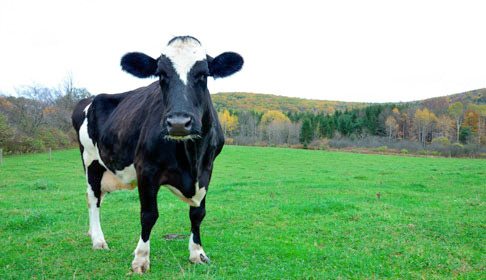
dairy cow

Fanny, a “spent” milker, was rescued by Farm Sanctuary too

Milk doesn’t do a body good

Milk will turn a small calf into a 1000-pound cow. It does the job well, but I don’t want to grow that big. I don’t want to drink hormones and antibiotics. I don’t want to fuel disease. Milk has too much protein, and we excrete the excess–along with calcium from our bones! It taxes our kidneys, and increases our risk of osteoporosis, diabetes, cancer, heart attack and stroke. I get calcium just like cows do: from dark leafy greens. Milk doesn’t have fiber, but it is full of cholesterol and fat. Who needs it (well, besides cows)?

It doesn’t matter if milk comes from a small, organic dairy farm or a large corporation. These things remain constant:

  • Cows are kept constantly pregnant;
  • Calves are taken from their mothers, killed, sold for veal, or raised to be milkers;
  • “Spent” dairy cows end up as hamburgers.

I wouldn’t drink milk from a dog or a monkey so why drink milk from a cow? After infancy, no other animal even drinks milk at all–not even from their own species!

So next time you think about life without dairy, think about the animals who suffer for our taste buds.

Alternatives

With a plethora of dairy-free alternatives, you won’t miss milk. We have choices like dark chocolate, coconut yogurt, hemp, oat, soy, almond and rice milk, non-dairy creamer, sorbet and soy or coconut ice cream, and delicious vegan cheeses from companies like Daiya and Tofutti.

Daiya

Dump dairy and ditch cruelty!

Unknown's avatar

Gearing up for Farm Sanctuary’s Walk for Farm Animals

In less than two weeks, September 21st to be exact, the 2013 Walk for Farm Animals comes to Seattle. The event is organized by Farm Sanctuary, the largest farm animal shelter in North America. Farm sanctuary’s mission is to protect farm animals from cruelty, inspire change in the way society views and treats farm animals, and promote compassionate vegan living.

Walk for Farm Animals T

That’s why I’ve joined the event and have started raising funds for the cause. The purpose of my blog isn’t to solicit money, but if you’re interested in donating to a great cause, I’d love that! Of course if you’re in the area (or in a participating city), you’ll probably have fun joining the event and raising your own pledges.

I’m walking for Mesa, a friendly hen who escaped the brutal world of cock-fighting; for Winston, a scared piglet who escaped a live market in New York City; for Mark, a lamb who was sick and headed to slaughter; and for Michael, a dairy calf who was on his way to becoming veal.

There are many other stories like the ones above, and that’s why I support Farm Sanctuary  (I even have a Farm Sanctuary credit card, so a small portion of my purchases can help animals).

Won’t you walk with me?

Unknown's avatar

Japan Dolphin Day

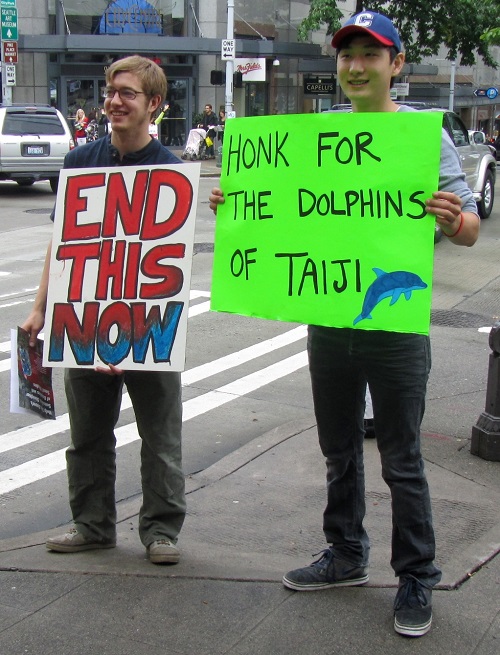
Today is Japan Dolphin Day and more than 16,000 people are joining 117 events all over the world to raise awareness of the annual dolphin hunting season that started on September 1st in Taiji, Japan.

dolphin sign

Every year, thousands of dolphins are captured and slaughtered in Taiji, by a small group of fishermen. For too long, this information was kept from the Japanese public and the rest of the world. The Oscar-winning documentary, The Cove, brought the horrors to light a few years ago.

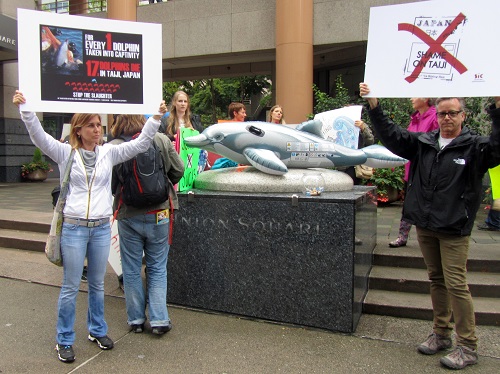
dolphin demo

We marched from Westlake Plaza, an outdoor square in downtown Seattle, to the Japanese Consulate a few blocks away. At the consulate, we held signs for passers-by and handed out literature to raise awareness of the issue. Some people knew, others were shocked by what they learned.

dolphin slaughter protest

Dolphin meat isn’t a profitable venture, but the fishermen in Taiji can make a killing by selling live dolphins to marine parks around the world. For every performing dolphin, 17 of his friends and family are killed. Incredibly, dolphin trainers are in the boats with fishermen, picking the best candidates for marine parks. The rest are slaughtered.

protesters at Japan Dolphin Day

Dolphin meat, isn’t healthy or safe (it’s loaded with mercury and PCBs) but it’s distributed to children in the school lunch program anyway.

Japanese Consulate

The Japanese public hadn’t been aware of these atrocities until recently. Now that they know, they’re starting to do something. Brave activists from Japan and other countries are in Taiji now, protesting the slaughter. It’s especially significant that concerned Japanese are joining the efforts. Their culture doesn’t encourage speaking one’s mind, protesting in the streets, and questioning the government. But they are, and I applaud them.

Jean and Claudine

Back in Seattle, far from Taiji, we showed our support for the activists in Japan and let the Japanese government know that we do not condone this abuse of our friends of the sea.

Resources

dolphin collage

Unknown's avatar

The sad lives of carriage horses

I love New York, but one of the things I don’t like about the city that never sleeps is the carriage horse industry.

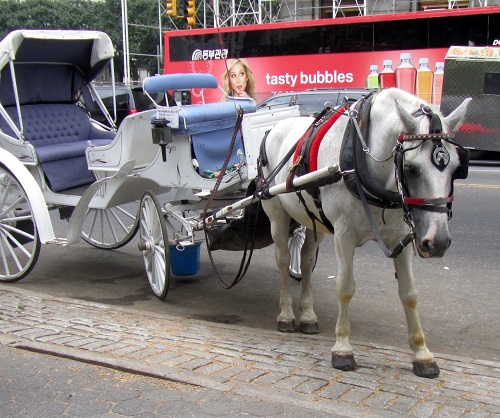
Many cities, including the one I live in (Seattle) and one I visited this spring (Savannah), offer horse-and-carriage rides. Approximately 1000-2000 horses are used across the country. These hansom cabs, might evoke an old-world feeling but they’re anything but romantic. Carriages belong in the history books.

sad horse

Horses in the carriage industry are often castoffs from the harness racing industry or from Amish communities and come to the city with pre-existing health problems. They develop further health issues from walking on pavement all day and breathing exhaust from trucks, cars and buses. They work all day in freezing cold and scorching heat and they’re stored in warehouses at night.

They’re never sent out to pasture, and have no government protection. Carriage owners are legally allowed to work their horses 9 hours a day, seven days a week–whether horses like it or not.

don't take a ride

The average working life of a carriage horse is only four years. In fact, about a third, or approximately 70, of the New York City carriage horses are eliminated from the Department of Health horse registry every year. When they’re spent, they’re usually auctioned off for slaughter or rendering plants for dog food companies or zoos.

stuck in traffic

The horses suffer and people are endangered too. Horses get spooked easily and can run into traffic. In New York there have been more than 18 accidents involving horses in the past two years. It’s a largely unregulated industry.

It’s a half-hour ride for patrons, but it’s a lifetime of misery for the horses.

Toronto, Paris, London, Las Vegas, Beijing and many other cities have already banned carriage horses. A fun horseless carriage idea is brewing that could replace horses in New York and still be fun and romantic.

In Savannah, I opted to take a pedicab ride. The man peddling told me he enjoys the job and that it’s paying for his college.

pedicabs instead

What to do?

  • Never patronize carriage rides, and tell your family and friends why they shouldn’t. From newlyweds to tourists, it’s the people paying for the rides that keep this industry in business.
  • If your city allows carriages on city streets, urge your legislators to propose legislation that will ban it.

Update (Jan 2, 2014) – New York City Mayor-elect Bill de Blasio has vowed to ban horse-drawn carriages in the city and retire the horses to sanctuaries. Money to help the horses is probably still needed and horses in other cities still need help. This promise is great news, and a good way to keep momentum going for the horses.

Resources:

Unknown's avatar

Bird-brained: Animal name calling

Sly like a fox. Eagle eyes. Busy as a beaver.

There are a lot of animal-themed metaphors, similes and idioms in our vernacular. They’re so second-nature that I rarely notice myself saying them. Some expressions come from an animal’s natural characteristics and I don’t mind using them.

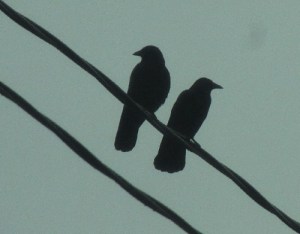
two crows

What’s wrong with being a night owl, for instance?

Other times, expressions belittle animals of have an inherently cruel theme. Yes, stick and stones may break bones, but words are powerful and I’m trying to adopt a more inclusive vocabulary. Not because it’s politically correct but because the way we talk affects the way we think. I’ve already written about animals and gender-specific pronouns, and now I’ve compiled a list of some expressions I’m trying to avoid:

  • Too chicken (to do/say something); chicken out
  • Pig, pig out, or eat like a pig
  • Ugly as a toad
  • More than one way to skin a cat
  • Chicken in every pot
  • Bleed like a stuck pig
  • Like a chicken with its head cut off
  • Kill two birds with one stone
  • Not enough room to swing a cat
  • Kill the fatted calf
  • So hungry I could eat a horse
  • No point beating a dead horse
  • A bird in the hand is worth two in the bush
  • Shooting fish in a barrel
  • Bigger fish to fry
  • Big enough to choke a hog
  • Don’t count your eggs before they’ve hatched
  • Like a lamb to slaughter

Here are some that I think are fun and appropriate:

  • When pigs fly
  • Gentle as a lamb
  • Have your tail between your legs
  • Water off a duck’s back
  • An elephant never forgets
  • Let sleeping dogs lie
  • It’s a dog’s life
  • Every dog has his day
  • Horse around
  • In the doghouse
  • Raining cats and dogs
  • Quick as a rabbit
  • Two shakes of a lamb’s tail
  • Eagle eyes
  • Sharp as a hawk
  • Birds of a feather flock together
  • Lion-hearted

I’m not going to go ape and bark up the wrong tree if you don’t take the bull by the horns, but can you think of other suitable or inappropriate expressions? Can you think of alternatives for the unsuitable ones?

Unknown's avatar

My vegan dog

My dog eats vegan dog food. Have I lost my mind? Am I forcing my beliefs on my poor dog? Not at all! Let me explain.

Frankie is an 11-year-old rat terrier. Ever since I adopted him when he was five, I was interested in feeding him the healthiest food I could find. I started with a high-quality, human-grade, fish-based food, thinking I’d be avoiding factory-farmed meat. But fish is often factory farmed too. And the oceans are being depleted, so wild-caught is just as bad. Fish are sentient beings and I couldn’t justify it.

Later, I made Frankie homemade vegan meals, to which I added Vegedog, a powdered supplement especially made for dogs. Frankie loved it, but planning his meals was a lot of work. Besides, Frankie will eat anything. Cheap kibble, human food, garbage, cat poo. I felt like my culinary skills were being taken for granted.

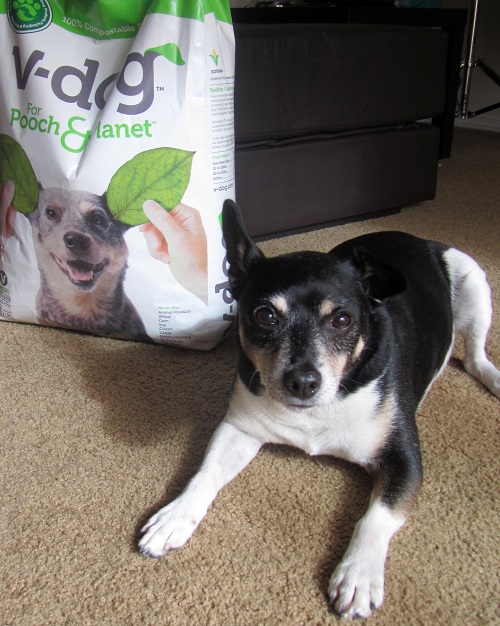
frankie with his v-dog

Then I found V-Dog, a cruelty-free kibble. It’s free of wheat, corn, soy, fillers, GMOs–and of course animal products. Frankie loves it. He has lots of energy, and “clean up” is better too (by which I mean, good in, good out).

As for me forcing my beliefs on Frankie, here’s how I see it. In the wild (well, dogs are domesticated, but you know what I mean) dogs wouldn’t be eating prepackaged food. They wouldn’t be chemical-laden, not-fit-for-human-consumption castoff meat bi-products from factory farms. Reality is, most commercial dog food is crap. The parts of the animals that people don’t eat are sent to rendering plants for pet food. The diseased animals, the ones with tumors, even roadkill and euthanized cats and dogs, can end up in dog food.

In the wild, Frank would be a scavenger, an omnivore. He loves watermelon, but he won’t turn down meat. For him it’s not a moral issue. For me it is. I had a hard time aligning my vegan values with the fact that I bought him meat-based food. Heck, some pet food companies even test on animals. Luckily with V-dog, I don’t have to compromise.

There are other vegetarian dog foods on the market (like Evolution, Ami Dog, and Natural Balance vegetarian formula) and if you have a dog, I’d encourage you to try a few and find one that suits him or her best. I chose V-Dog because it’s a vegan-owned business and is recommended by a host of organizations, from veterinarians to animal sanctuaries.

Resources:

Unknown's avatar

Farm Sanctuary message gear

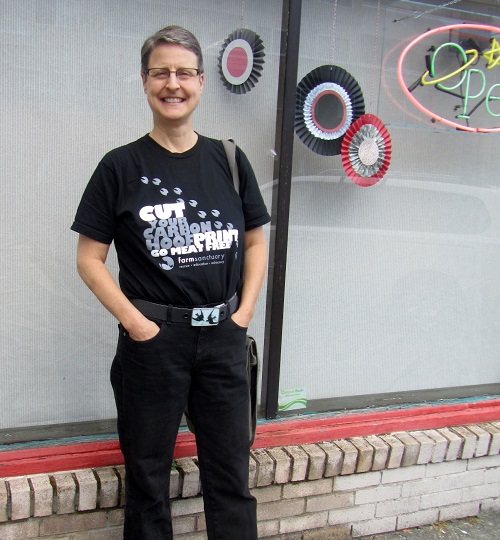
I recently met up with my friend Barb, of healthnik.org. We caught up over lunch at Araya’s, a vegan Thai restaurant in Seattle’s university district. Their all-you-can-eat buffet is not to be missed! After lunch, we walked a few doors down to Vegan Haven, Seattle’s only all-vegan grocery store. I got Barb to pose for me out front. It seemed like a good backdrop for a photo shoot featuring vegan wear.

Barb bought her belt at Vegan Haven. It’s made of recycled conveyor belt. She replaced the plain buckle with a unique bird buckle from the co-op in Mount Vernon.

Barb had just come back from New York State and told me about her experience visiting Farm Sanctuary.

Barb in FS gear

T-shirt: Farm Sanctuary
Jeans: Calvin Klein via Goodwill
Belt: Held Belts
Belt buckle: FluffyCo
Bag: Farm Sanctuary

The tour was a very positive experience. She got to meet a lot of rescued animals and learn about each of their unique stories. While she was there, she picked up a few pieces of merch.

Barb is wearing a T-shirt from Farm Sanctuary with a vegan/environmental message: Reduce your carbon hoofprint: Go meat-free! Environmentalism and veganism go hand-in-hand. Factory farming is a bigger source of carbon emissions and pollution than all the transportation industries combined!

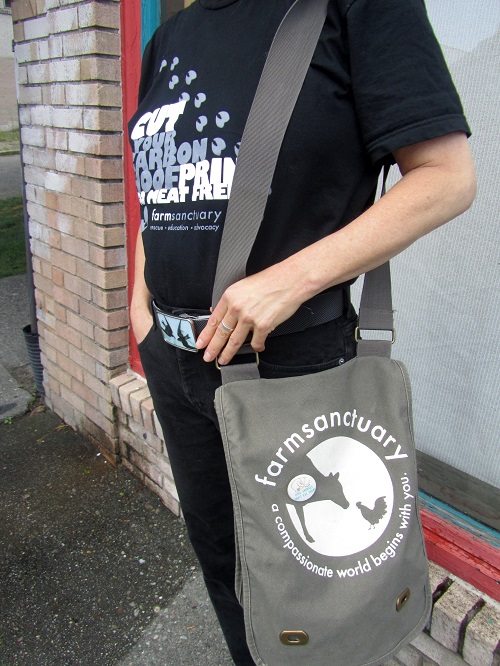
Barb also picked up a great shoulder bag. It looks perfect for carrying a couple of books or magazines. It would fit a camera nicely too, and probably is big enough for a tablet or iPad. Plus, the message is clear.

Shoulder bag

Barb was thoughtful and brought me a pin and magnet. The magnet is on my fridge. Look at that cute lamb!

lamb

I think everyone should visit a sanctuary. If you’re not vegan, you’ll see first-hand why ditching meat, milk, and eggs is a great idea. If you’re already vegan, you’ll be uplifted by seeing the ones who made it out–animals who were destined for the dinner table and were saved because of the hard work of the Farm Sanctuary people (and donations from its supporters).

Farm Sanctuary has locations in New York and California, but there are many other sanctuaries. Your area might even have one. If not, planning a trip near a sanctuary is a great reason to visit one.