This past Saturday, I joined several hundred demonstrators at the University of Washington for the March on UW. We were protesting a proposed animal testing facility that, if built, would see a 30% increase in the number of animals tortured and killed at the university.
No New Animal Lab is a slogan, a campaign, and a movement to prevent thousands of animals from suffering. Their current target is Skanska, the construction company who has been awarded the project.
Wendy, Scott, Jean
a world of good? think again – c/o Wendy
bridge with protesters
A recent exposé on a local news channel has sickening information about some of what goes on at the university. It’s inhumane, and it needs to stop. I’ve written before about how animal testing is never justified, and the examples at UW are exactly why.
There are psychopaths in our midst. They are researchers at the UW and they live off federal grant money, despite a history of abuse and fines by the USDA.
At a time when other schools are moving to more modern, accurate testing methods, the UW chooses to invest more money in animal testing and refuses to recognize that animal testing models are outdated.
sign of the times – c/o Wendy
speeches before the march – c/o Wendy
marching on 45th St. – c/o Wendy
We marched through campus, to the site of the proposed lab, and up University Avenue. After the march, a smaller–but substantial–group protested outside of the home of one of the UW Regents, a man who is pushing the lab plans through despite public opposition.
Police presence was heavy, but both events were peaceful.
The events generated a lot of media coverage, including TV, newspaper and radio. Momentum is gaining and more and more people are becoming aware.
It frustrates me that I can’t earmark my tax dollars and funnel them into education, healthcare, and parks instead of cruelty.
Just when I thought I’d heard it all, I read a New York Times article about a taxpayer-funded animal research facility in Nebraska. This horrific lab conducts research on farmed animals to benefit the meat industry. They receive $22 million dollars of taxpayer money a year to torture and abuse animals. The experiments are so gruesome even people in the animal agriculture industry are appalled!
I’m grateful to the whistleblowers who shed light on this atrocity (and the journalists who ran with the info and got the story published). The NYT article exposes experiments at the 50-year-old U.S. Meat Animal Research Center.
At the Center, animals are genetically modified to produce more offspring–and the result is often babies who are born with horrendous deformities. Vet care is inadequate, “caretakers” aren’t properly trained, animals are starved to death, and newborns are left to die in open fields.
This is all in the name of higher yields and bigger profits. Researchers are looking for ways to produce heartier animals and more meat. It’s a twisted tale that belongs in a sci-fi movie–but it’s reality.
Sadly, cows, pigs, and sheep are excluded from protection under the Animal Welfare Act (AWA). Only Congress can stop such egregious animal suffering by making changes to the Act.
Please tell your legislators that you are outraged that federal government funds are used for such cruelty and that it must be stopped. Politely tell them that ALL animals deserve protection under the Animal Welfare Act.
There are so many reasons why I want nothing to do with the meat industry. I don’t willingly give them any of my money. I hate that they get taxpayer funding. With enough public pressure, taxpayer–who also happen to be voters–can get this place shut down!
In Seattle, NARN organized a protest outside of the UW Primate Research Center at 3010 Western Ave. The infant primate research that goes on behind the walls of the grim facility haven’t produced cures for human diseases and further prove that animal testing is a bad idea.
At SeaTac Airport, The Bunny Alliance met to protest Delta Air Lines. Delta has a partnership with Air France, one of the few airlines that ship animals to labs. Many primates are imported from places like China and Vietnam. Without animals, labs wouldn’t have their research subjects and breeding farms wouldn’t make money by raising primates for labs.
What can I do?
There’s lot’s you can do! Putting pressure on businesses and government is essential. The EU recently banned the use of animals in cosmetic testing, as have Israel and India. Here are a few things you can do:
Don’t support charities that test on animals. Here’s a page you can use to check your favorite charities.
Only shop from companies that don’t test on animals. Here’s a page with a list of companies.
Check out Chimpanzee Sanctuary NW and check out the progress of theses former research chimps.
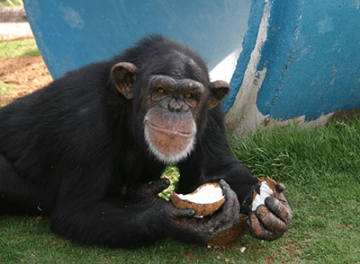
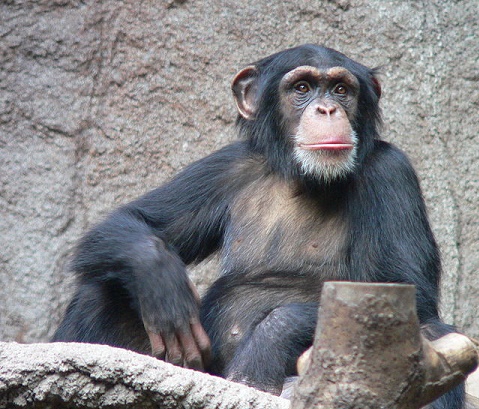
The National Institutes of Health (NIH) recently announced that it has accepted the Institute of Medicine’s recommendation of retiring over 300 of its chimpanzees. The US has been experimenting on chimpanzees for 90 years and is the last country in the industrialized world to do so. This news has been a long time coming.
The chimps’ similarity to humans makes them coveted for research, but it’s this very similarity that poses an ethical dilemma. Besides, chimps are different to many ways. They have different immunities and reactions to diseases and drugs. For example, if chimps are purposefully infected with HIV, they rarely even show symptoms of AIDS. We can’t help humans by using animal testing models.
Regardless of similarities and differences, no animals should be used as research subjects, so it’s a great piece of news that most of the chimps will be retired.
The news is mixed though. Fifty chimps will remain with NIH. They won’t be bred, but that’s not enough. These intelligent, self-aware beings deserve to live out their lives at a sanctuary like Chimpanzee Sanctuary NW. Each one is an individual with unique traits and should be given the right to live free from harm and experimentation. It’s the least we can do, even though we owe them far more than that.
Chimpanzee Sanctuary NW has written about the NIH decision. I’ll be on the lookout for petitions to free the remaining 50 and I’ll post links to one as soon as I find it.
Good news on the horizon: The US Fish and Wildlife Service is proposing that chimpanzees in the US be added to the federal endangered species list.
Right now, wild chimps are listed as endangered while their captive cousins are listed as only threatened. This means people can breed, sell, ship, and experiment on captive chimps in the US.
Adding captive chimps to the endangered species list would change that and would help chimps in zoos, circuses, and in the entertainment industry.
Changing their status will prevent chimps from being used in invasive medical testing procedures and from being taken across state lines. It would also ban the international commerce of chimps.
You can read the press release from Chimpanzee Sanctuary NW and an article by the Washington Post for more about the chimps’ plight.
Take Action!
The US Fish and Wildlife Service is taking public feedback about the issue. Please visit this Humane Society page, add your comments, and sign the petition asking US Fish and Wildlife Service to help all chimpanzees by applying Endangered Species Act protections to captive chimpanzees.
This past Saturday The Northwest Animal Rights Network (NARN) held a demo outside the University of Washington National Primate Research Center. We organized the event to coincide with World Week for Animals in Labs.
Hidden inside this dark, unmarked building, 700 primates live and die for research, subjected to painful surgeries and traumatic procedures until they aren’t useful anymore. The Blue Building at 3000 Western Avenue downtown Seattle is the main facility for the UW National Primate Research Center, the largest of eight across the country.
About a dozen of us spent a few hours with signs and fliers and shared info with passers-by. Many people were shocked to learn that wasteful and cruel experiments were happening in their neighborhood. The beautiful Seattle sculpture park is across the street, and no one suspects cruelty is around them.
The University of Washington spends millions of taxpayer dollars conducting needless tests that haven’t resulted in any contribution to humans or animals. Harvard recently decided to close its primate research center and it’s time for UW to do the same.
The UW has even been cited with safety and cruelty violations including performing unauthorized surgeries and letting a monkey starve to death. The university breeds monkeys too and removes babies from their mothers soon after they’re born.
We demo to let the public know about these atrocities but we also demo to let animal abusers know their deeds aren’t going unnoticed. As I’ve written about before, animal research isn’t good science.
What can you do?
Send a polite letter requesting the UW reevaluate its policies regarding animal experimentation and commit to long-term reduction of the use of any animals for science.
Michael Young, President
301 Gerberding Hall, Box 351230
Seattle, WA 98195
206-543-5010
pres@uw.edu
The University of Washington Board of Regents
139 Gerberding Hall, Box 351264
Seattle, WA 98195-1264
206-543-1633
regents@uw.edu
If you’re a UW grad, you can also contact the alumni association and tell them that you won’t join them (or that you’ll be cancelling your membership) unless the university agrees not to use live animals in their research.
UW Alumni association Box 359508
Seattle, WA 98195-9508
206-543-0540 or 1-800-AUW-ALUM uwalumni@uw.edu
Every year millions of animals are subjected to cruel experiments in the name of cosmetics, medicine and even transportation. They are poisoned, burned, gassed, shocked, overdosed, crushed, blinded, operated on, and deprived any semblance of a quality life. Not only is this cruel, it’s unnecessary. It’s outdated, it’s wasteful, and it’s downright dangerous to humans.
If animals are so different from us (different enough for us to justify experimenting on them), it also means they’re too different to gather relevant, conclusive evidence that would apply to us. If they’re similar enough that the experiments would actually be useful and relevant, then they’re just like us and it’s unethical to test on them.
The cost of experimenting on animals is high and the benefits are minimal. Non-animal testing is usually cheaper and more accurate than animal tests, which can be unreliable. Animal tests are misleading because they’re not good at showing how humans will respond.
With animal testing, illness is induced, and then a cure is sought. That’s an unrealistic and unnatural environment and doesn’t translate well to humans. According to the AAVS, nine out of ten drugs that appear promising in animal studies go on to fail in human clinical trials.
For example, the polio vaccine was delayed by decades because of animal testing. Monkeys respond differently to the virus. Penicillin almost didn’t see the light of day because it was ineffective on rabbits (and killed guinea pigs). It wasn’t until Alexander Fleming gave it to a dying patient (as a last-ditch effort) and she recovered that it was proven acceptable for human use.
Thalidomide, a drug used in the 1950s to treat morning sickness, was proven harmless in dogs, cats, rabbits, monkeys, and rats, and was cleared for human use. It wasn’t until over 10,000 children were born with severe birth defects that it was pulled from the market. Animal tests didn’t warn us.
More recently, Vioxx, a painkiller for people with arthritis, was taken off the market after it caused up to 320,000 heart attacks and strokes. The drug was tested on animals but those tests never revealed the danger to people.
So if people have felt animal testing is unethical, why has it continued? Animal testing is big business and gets a lot of grant money. Careers depend on it. It’s also based on old laws and older science–both of which are outdated. You can learn more about this “bad science” by watching a video featuring animal testing opponent Dr. Andre Menache.
Just because some progress seems to have been made via animal testing doesn’t mean that the results wouldn’t have been found out without animals. If I take a flight from New York to Los Angeles with a stopover in San Francisco, it doesn’t mean you can’t get there with a stopover in Atlanta. Or maybe just fly non-stop. There are many ways to reach the same result.
We have the technology to use alternatives to animal tests–and there are many! We have mathematic and computer models, genomic tests, human cell cultures, medical imaging, and crash test dummies. Working on human cadavers to train for surgery is more beneficial than practicing on live animals.
We don’t need animal testing. So vote with your dollars: Don’t support companies that test on animals. Here’s a downloadable list of companies that test and don’t test from vegankit.com, as well as a searchable online list from PETA. Before you support a charity, make sure they don’t test by checking out this list from GEARI.





 Sunshine and Slaughter